SaaS Product Development: Roadmap, Framework and Strategy for 2026
Introduction
Building a SaaS product is one thing. Building the right SaaS product, in the right order, for the right customers, with a strategy that compounds over time, that is another challenge entirely. The difference between SaaS products that grow and those that stall is almost never technical. It is strategic.
This guide explores the frameworks, roadmap approaches, and strategic principles that distinguish high-growth SaaS products from expensive experiments.
What Is SaaS Product Development Strategy?
A SaaS product development strategy is the set of deliberate decisions that determine what you build, when you build it, and why. It connects your product vision to your business goals and your customers’ needs, and it provides a framework for prioritizing resources, always the most constrained variable in any SaaS company.
Without a clear strategy, SaaS teams build features based on whoever asked most recently. With a clear strategy, every sprint moves the product meaningfully closer to the goals that matter.
The SaaS Product Development Roadmap
A SaaS product roadmap is a high-level plan that communicates what the product team is building, in what order, and why. It is not a Gantt chart with hard deadlines, it is a strategic document that aligns the team and communicates direction to stakeholders.
What a good SaaS product roadmap includes:
- Now / Next / Later horizons: what is in active development, what is coming soon, and what is planned for the future
- Themes: strategic areas of focus (e.g. ‘improve onboarding’, ‘launch integrations’, ‘enterprise readiness’)
- User outcomes, not just features: ‘Reduce time to first value from 7 days to 1 day’ is more useful than ‘Add onboarding wizard’
- Dependencies and sequencing: which features must be built before others can begin
- Confidence levels: high-confidence items are committed; lower-confidence items are exploratory
Roadmaps should be reviewed and updated at least quarterly. A roadmap that has not changed in six months is a warning sign, either nothing was learned, or the team is not listening to users.
SaaS Product Development Frameworks
Jobs to Be Done (JTBD)
JTBD is a framework for understanding why customers hire your product. Instead of thinking about features, you think about the jobs users are trying to accomplish. ‘When I am in this situation, I want to accomplish this goal, so that I get this outcome.’ This framing keeps product decisions grounded in real user needs rather than assumptions.
Opportunity Solution Trees
Popularized by Teresa Torres, this framework connects desired outcomes to opportunities (customer needs, pain points, or desires) and then to potential solutions. It prevents solution-first thinking and ensures every feature traces back to a real customer opportunity.
OKRs (Objectives and Key Results)
OKRs are widely used in SaaS product teams to set ambitious goals (Objectives) and measure progress with specific, quantifiable indicators (Key Results). They work well at both the company level and the product team level, creating alignment without micromanagement.
The RICE Scoring Model
RICE, Reach, Impact, Confidence, Effort is a prioritization framework that helps product teams compare features objectively. Each feature gets a score based on how many users it affects (Reach), how significantly it changes their behavior (Impact), how certain you are of those estimates (Confidence), and how much work it requires (Effort). High RICE scores go to the top of the backlog.
SaaS Product Development Strategy Principles
Start narrow and expand
The most successful SaaS products start by solving one problem for one type of customer extraordinarily well. Notion started as a notes tool. Slack started as an internal communication tool at a gaming company. The temptation to build a broad product from day one is one of the most common causes of SaaS failure.
Build for the user who pays, not the user who uses
In B2B SaaS, the person who buys the product is often different from the person who uses it. A CFO buys the accounting software; the accounts payable team uses it. Your product must delight the user (or they will complain and churn) and satisfy the buyer (or they will not renew). Both personas must be understood.
Define success metrics before you build
Every feature should have a defined metric that will tell you whether it worked. ‘More engaged users’ is not a metric. ‘40% of new users complete onboarding in their first session’ is a metric. Build with measurement in mind.
Ship faster, learn faster
A feature that ships in six weeks and is wrong costs more than a feature that ships in two weeks and is partially right. SaaS product development strategy favors speed to learning over perfection at launch.
Product-Led Growth (PLG) vs Sales-Led Growth (SLG)
One of the most significant strategic decisions in SaaS product development is your go-to-market motion:
Product-Led Growth: The product itself drives acquisition, expansion, and retention. Users sign up without talking to sales, experience value quickly, and convert to paid when they hit limits. Examples: Slack, Dropbox, Figma, Notion.
Sales-Led Growth: A sales team drives customer acquisition. The product needs to be sophisticated enough to justify the sales process, typically enterprise SaaS with complex security requirements, custom contracts, and long procurement cycles. Examples: Salesforce, Workday, SAP.
Many modern SaaS companies use a hybrid: a PLG motion for SMBs and a sales-led motion for enterprise. Getting this right is a strategic decision, not a product decision, but it has enormous implications for what you build and in what order.
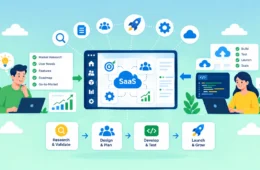
Building Your SaaS Product Development Roadmap: Practical Steps
Step 1 Anchor to outcomes: Start with your company’s top 2-3 goals for the next 12 months. Every roadmap theme should connect to at least one of these.
Step 2 Collect and synthesize insights: Gather input from users, sales, customer success, and competitive analysis. Look for patterns in what is causing friction and what is driving delight.
Step 3 Generate opportunities: Frame what you learned as opportunities: ‘Users struggle to understand their usage data’ or ‘Enterprise prospects require SSO before they can sign contracts.’
Step 4 Prioritize with a framework: Apply RICE or another scoring method to rank opportunities. Gut feel has its place, but systematic scoring reduces the influence of whoever shouted loudest.
Step 5 Plan the Now / Next / Later horizons: Move your highest-priority opportunities into Now, your next set into Next, and your longer-horizon ideas into Later.
Step 6 Communicate and align: Share the roadmap with engineering, design, sales, and leadership. Get early feedback before the team is deep in execution.
Conclusion
A SaaS product development strategy is not a document you write once. It is a living system for making better decisions faster, about what to build, what to defer, and what to cut. The frameworks and principles in this guide will not tell you what to build, but they will give you the tools to figure it out with your team and your users.
Software Flux Solutions works alongside product teams at every stage of SaaS product development from defining the initial roadmap through to executing an agile development process that delivers real results.

Zainab Bibi
Senior SAAS Project Manager
1+ Years of Experience in SAAS Projects Management