Multi-Tenant SaaS Development: Architecture, Trade-Offs and How to Build It Right
Multi-tenancy is the architectural principle that makes SaaS businesses economically viable. Without it, every new customer would require their own dedicated infrastructure stack. With it, a single application serves thousands of customers simultaneously, with each customer’s data kept completely separate from all others, on shared infrastructure that costs a fraction of what isolated deployments would require.
For any UK business planning to build a SaaS platform, understanding multi-tenant architecture is not optional. It is foundational. The decisions you make about how to implement multi-tenancy will affect your security posture, your operational costs, your compliance obligations, and your ability to scale for years to come.
What Multi-Tenant SaaS Development Actually Means
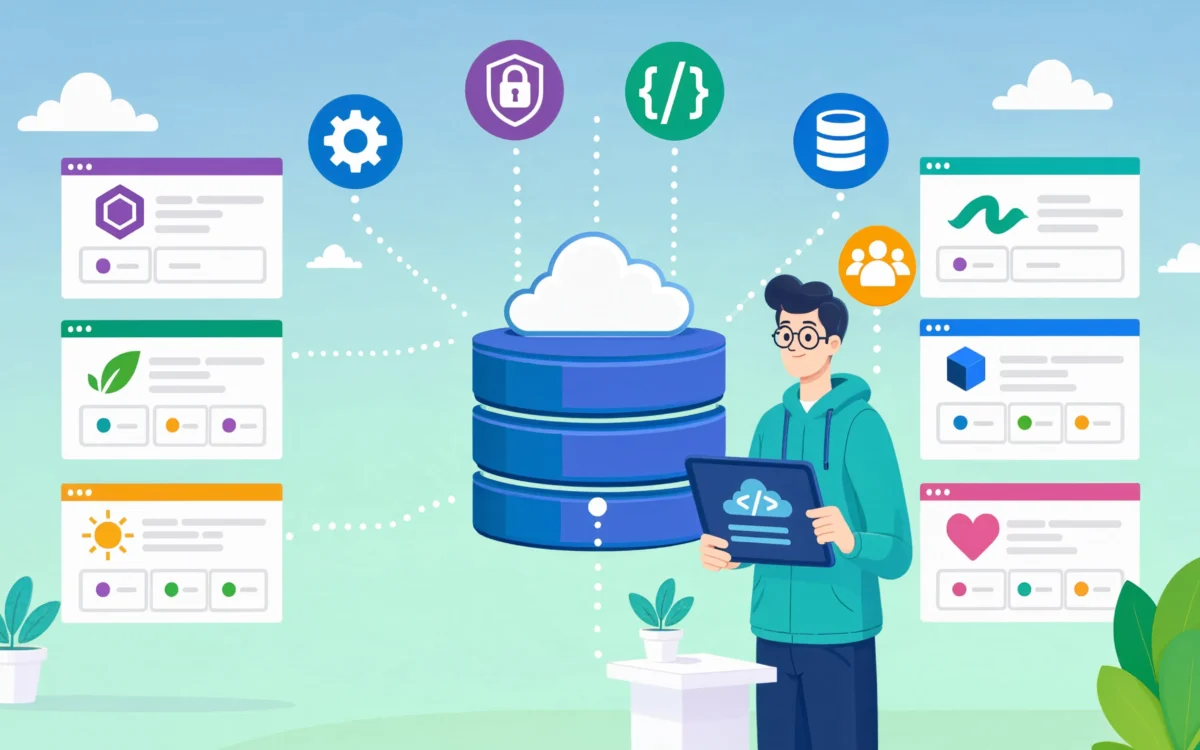
A tenant, in SaaS terminology, is a customer organisation. Multi-tenancy means that a single instance of your application serves multiple customer organisations, each of which sees only their own data and operates within their own configuration, even though they are using the same underlying codebase and may be sharing the same database infrastructure.
The key capability that multi-tenancy provides is isolation: the guarantee that Customer A can never see, access, or interfere with Customer B’s data, regardless of how the application handles them. Achieving this isolation at the right level of the stack, for the right cost, given your security and compliance requirements, is the core challenge of multi-tenant architecture design.
The Three Multi-Tenancy Models
Shared Database, Shared Schema
All tenants share the same database tables. A tenant ID column on every relevant table identifies which organisation each record belongs to. Application-level logic enforces that every query filters by the current tenant’s ID.
Advantages: Lowest infrastructure cost. Simplest to manage. Easiest to deploy schema updates across all tenants simultaneously.
Disadvantages: A bug in the tenant filtering logic could expose one tenant’s data to another. Compliance-heavy industries (healthcare, finance, legal) will require additional justification for auditors. Performance isolation is limited: a single large tenant’s heavy queries can affect other tenants.
Best for: Low-sensitivity applications, early-stage SaaS products, applications where compliance requirements are modest.
Shared Database, Separate Schemas
Each tenant has their own schema (namespace) within a shared database. Tables exist separately for each tenant, but the database server is shared.
Advantages: Better logical isolation than shared schema. Data from different tenants cannot be accidentally commingled at the query level. Schema changes can be deployed tenant by tenant if needed.
Disadvantages: More complex to manage as tenant count grows. Schema migrations across hundreds of tenant schemas require careful orchestration.
Best for: Mid-market SaaS products where moderate isolation is required but full database separation is not justified by compliance or contract.
Separate Database Per Tenant
Each tenant has a completely dedicated database, often on shared or partially dedicated infrastructure.
Advantages: Maximum isolation. No possible data commingling. Supports highly sensitive compliance requirements. Allows per-tenant database-level controls (encryption keys, backup schedules, geographic data residency).
Disadvantages: Highest infrastructure cost. Most complex to manage. Schema migrations require updates across potentially thousands of individual databases.
Best for: Healthcare platforms (HIPAA, NHS data standards), financial services applications, legal and professional services platforms, and enterprise SaaS with contractual data isolation requirements.
Row-Level Security: A Critical Safeguard
Regardless of which tenancy model you choose, row-level security (RLS) should be implemented at the database level, not just the application level. Application-level tenant filtering can be bypassed by a code bug. Database-level RLS policies enforce isolation at the query execution layer and cannot be circumvented by application logic errors.
PostgreSQL, which is the database we use for the majority of SaaS development engagements at Software Flux Solutions, has excellent native support for row-level security policies that make this implementation clean and auditable.
Building the Tenant Context Layer
Every request to a multi-tenant application must establish tenant context at the earliest possible point in the request lifecycle: typically at the routing or middleware layer, from the subdomain, the JWT claim, or the session token. This context is then propagated through every subsequent layer of the application, ensuring that every database query, every cache key, and every external API call is scoped to the correct tenant.
The most common architectural failure in multi-tenant systems is inconsistent tenant context propagation: some code paths correctly scope to the current tenant, others inadvertently use a global query that returns data across all tenants. A rigorous code review process and automated multi-tenant isolation tests are essential to catch and prevent these errors.
Multi-Tenancy and the Booking System Pattern
Multi-tenant architecture is a core pattern in several of the platforms we build. Our booking system development practice regularly requires multi-tenancy for clients who operate booking platforms serving multiple venue operators, franchise locations, or independent businesses under a single platform. Each operator is a tenant with their own branded booking page, their own availability configuration, their own client data, and their own reporting dashboard, all served from a single multi-tenant application.
The same pattern applies in our marketplace development work, where each marketplace seller is effectively a tenant with isolated product listings, order management, and financial reporting.
Performance Considerations in Multi-Tenant Systems
Multi-tenancy introduces specific performance challenges that single-tenant systems do not face.
Noisy neighbour problem. In shared-infrastructure multi-tenancy, a high-traffic tenant can consume disproportionate resources and degrade performance for other tenants. Mitigation strategies include query timeouts, rate limiting per tenant, and dedicated read replicas for high-volume tenants.
Database connection pooling. With thousands of tenants potentially active simultaneously, naive database connection management will exhaust connection limits. A connection pooler like PgBouncer is essential for shared-database multi-tenant systems at scale.
Caching strategy. Caches in multi-tenant systems must always be scoped to tenant context. A cache key of recent_bookings is a security vulnerability. A cache key of tenant:12345:recent_bookings is correct.
Multi-tenant SaaS platforms typically require a level of interface sophistication that goes well beyond standard web design, since multiple tenant brands must be faithfully represented through a single underlying system without any visual bleed-through between client environments. Complex web design london agencies have developed particular expertise in this design discipline, having worked extensively with white-label SaaS clients in financial services, legal technology, and enterprise software where the visual quality of each tenant’s branded experience is a core product requirement rather than a cosmetic detail. For multi-tenant SaaS projects where the branding engine and per-tenant interface quality are central to the platform’s commercial positioning, seeking a development partner with direct experience in this design complexity level is worth the additional evaluation effort.
Compliance Implications of Multi-Tenancy Architecture
If your SaaS platform serves UK healthcare providers, financial services firms, or any sector with specific data residency or isolation requirements, your multi-tenancy model must be defensible to auditors and regulators.
Our healthcare CRM development projects consistently require separate-database tenancy with UK-based data residency and documented isolation controls. Our construction SaaS and solar management platforms typically operate at the shared-schema level, where the sensitivity of the data is lower and the compliance requirements are less prescriptive.
Starting Your Multi-Tenant SaaS Project
Choosing the right multi-tenancy model before writing a line of code is one of the most important decisions in the project. The wrong choice, discovered after launch, typically requires a complete data migration and significant refactoring of the application’s core query patterns.
Contact Software Flux Solutions to discuss your specific requirements. We will help you select the right tenancy model, design the isolation architecture, and build a platform that is secure, compliant, and genuinely ready to scale.

Zainab Bibi
Senior SAAS Project Manager
1+ Years of Experience in SAAS Projects Management