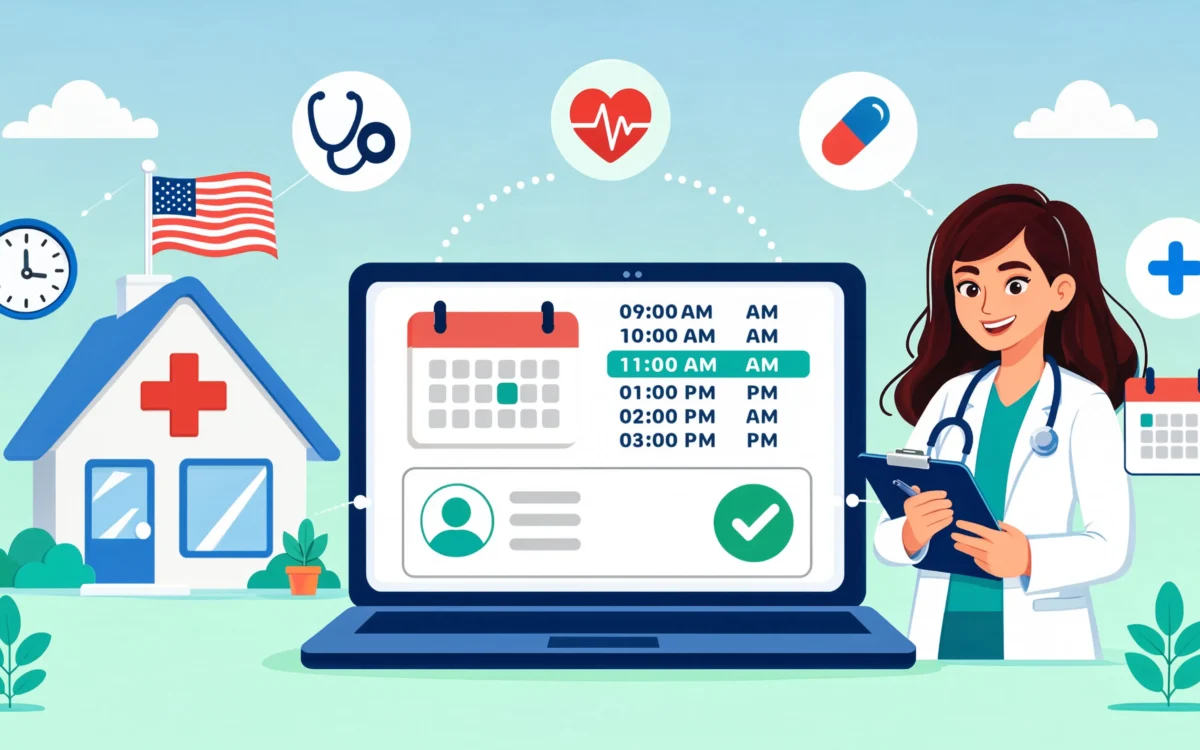
Appointment Scheduling Software for Healthcare: A Complete Guide for US Medical Practices
Appointment scheduling software for healthcare is not simply a logistics problem. It sits at the intersection of patient experience, clinical efficiency, regulatory compliance, and revenue cycle management. The software that manages your appointment flow touches almost every aspect of your practice’s performance.
Yet many US medical practices are still running on scheduling systems that were built before smartphones existed, or on generic booking tools that were designed for hair salons and fitness studios, not clinical environments. The result is patient frustration, staff inefficiency, compliance risk, and avoidable revenue loss.
This guide is for US healthcare practice managers, clinical directors, and healthcare technology decision-makers who want to understand what genuinely excellent appointment scheduling software looks like, what separates a compliant clinical platform from a consumer tool, and when custom development becomes the right answer.
The True Cost of Inefficient Healthcare Scheduling
Before evaluating any scheduling software, it is worth quantifying what poor scheduling actually costs.
A 10-provider practice running at 85% appointment utilisation with an average appointment value of $180 leaves $162,000 in annual revenue on the table from scheduling inefficiency alone. Add the administrative cost of managing no-shows, last-minute cancellations, and phone-based rebooking, and the true cost of an inadequate scheduling system often exceeds $250,000 per year for a mid-sized practice.
Against that baseline, investment in professional appointment scheduling software pays for itself rapidly.
HIPAA Compliance: The Non-Negotiable Starting Point
Every piece of appointment scheduling software used in a US healthcare setting must be HIPAA-compliant. This is not optional and it is not a marketing claim. It is a legal requirement under the Health Insurance Portability and Accountability Act, and failure carries penalties of up to $1.9 million per violation category per year.
HIPAA compliance in scheduling software specifically requires:
- All protected health information (PHI) encrypted at rest using AES-256 and in transit using TLS 1.3 or higher
- Role-based access controls ensuring that staff only access the appointment information relevant to their role
- Complete audit trails logging every access to and modification of patient scheduling records
- Automatic session timeouts on all staff interfaces
- Business Associate Agreement (BAA) in place between the software vendor and the practice
- Secure patient communication channels: encrypted messaging, not standard SMS or email
If a scheduling platform cannot provide a BAA, it is not HIPAA-compliant and should not be used for US healthcare scheduling under any circumstances.
Our healthcare CRM development practice builds scheduling platforms on HIPAA-eligible AWS infrastructure with all required safeguards implemented and documented from day one.
Core Features of Clinical Appointment Scheduling Software
Beyond HIPAA compliance, a scheduling platform built for clinical use must support the following:
Multi-provider scheduling. Each clinician has their own availability calendar, appointment type definitions, and booking rules. The platform must coordinate across all providers, preventing double-booking and managing shared resources (examination rooms, specialist equipment) correctly.
Appointment type management. A new patient consultation, a 15-minute follow-up, a telemedicine visit, and a procedure appointment all have different durations, preparation requirements, and resource needs. The scheduling system must handle each correctly and automatically.
Patient self-scheduling portal. A HIPAA-compliant patient portal that allows patients to book, reschedule, or cancel appointments online. This is now a standard patient expectation, particularly among the under-40 demographic, and practices without self-scheduling consistently report lower patient satisfaction scores.
Automated reminders and confirmations. Sent via HIPAA-compliant encrypted channels. Reminder timing and messaging should be configurable by appointment type. Studies consistently show that reminders sent 72 hours and 24 hours before an appointment reduce no-show rates by 30 to 50%.
Waitlist management. When a cancellation occurs, the system automatically notifies the next waitlisted patient and offers the available slot for immediate rebooking. This is one of the simplest and most impactful features for maximising appointment utilisation.
EHR and EMR integration. Scheduling data must flow bidirectionally with your electronic health records system. New patient information captured at booking should populate the EHR automatically. Appointment status updates from the EHR should update the scheduling system in real time.
Insurance verification. Integration with insurance eligibility verification services to check coverage status at the time of booking, not at the front desk on the day of the appointment. This eliminates one of the most common sources of claim rejection.
EHR Integration: The Technical Reality
EHR integration is where many healthcare scheduling platforms fall short. Most commercial scheduling tools offer integrations with a handful of the largest EHR systems (Epic, Cerner, Athenahealth) but struggle with the long tail of regional or legacy EHR platforms that many independent practices and community health systems use.
The standard for healthcare data interoperability in the US is HL7 FHIR (Fast Healthcare Interoperability Resources). A properly architected scheduling platform communicates with EHR systems via FHIR APIs, enabling reliable, standards-based data exchange that is not dependent on proprietary integration agreements.
For practices on legacy EHR systems without FHIR API support, integration requires custom middleware development: an integration layer that translates between the scheduling platform and the EHR’s proprietary data format. This is a significant but solvable technical challenge, and one we address regularly in our custom SaaS development engagements for healthcare clients.
Telemedicine Scheduling Integration
Post-pandemic, telemedicine has become a permanent fixture of US healthcare delivery. Appointment scheduling software must support telemedicine-specific workflows: generating unique, secure video links for each appointment, sending them to patients automatically, providing a virtual waiting room, and integrating with major telemedicine platforms or offering a native HIPAA-compliant video solution.
The scheduling platform should be the single source of truth for both in-person and virtual appointment types, with the distinction handled through appointment type flags rather than requiring two separate systems.
Multi-Location and Group Practice Requirements
For group practices, hospital-affiliated clinics, and multi-location health systems, scheduling complexity increases substantially. The platform must:
- Support independent scheduling configurations per location while enabling centralised management and reporting
- Handle patient assignment to specific providers based on location, specialty, language, or insurance network
- Provide network-wide capacity visibility so referring coordinators can identify the earliest available appointment across all locations
- Support cross-location resource sharing where applicable (specialist equipment, mobile providers)
These requirements are the primary driver of custom appointment scheduling software development in US healthcare. No single off-the-shelf platform serves all multi-location configurations well.
Healthcare web applications carry some of the most demanding interface requirements, compliance obligations, and data sensitivity considerations of any software category, and web application development london has produced a strong track record in this specific domain, driven partly by NHS digital transformation programmes and the substantial private healthcare sector concentrated in and around the capital. For US healthcare technology companies with UK operations or British market expansion plans, London-based development partners bring direct familiarity with NHS data standards, Information Governance requirements, and CQC compliance considerations that are genuinely difficult to acquire without having worked directly inside the UK healthcare market. This contextual expertise consistently accelerates the compliance-related architecture decisions that otherwise slow US-designed healthcare platforms during UK market adaptation.
What Does Healthcare Appointment Scheduling Software Cost?
For HIPAA-compliant custom scheduling platform development:
- Single practice (1 to 5 providers, core scheduling features): $40,000 to $90,000
- Group practice (5 to 20 providers, EHR integration, patient portal): $90,000 to $220,000
- Multi-location system (20 or more providers, HL7 FHIR integration, telemedicine): $220,000 upwards
For reference on what drives these investments, visit our booking system cost guide.
Practices across major US cities including New York, Los Angeles, Chicago, Houston, and Miami are making these investments as patient experience and operational efficiency become primary competitive differentiators.
Building the Right Platform for Your Practice
If your current scheduling system is limiting your practice’s growth, frustrating your patients, or creating compliance risk, a purpose-built appointment scheduling software solution is a strategic investment, not just an IT purchase.
Contact Software Flux Solutions to discuss your practice’s specific requirements. We will scope the right solution, provide a transparent cost estimate, and help you build a HIPAA-compliant scheduling platform that serves your patients and your practice for years to come. For US-based healthcare organisations, our website development USA practice can also ensure your web presence matches the quality of your scheduling experience.

Zainab Bibi
Senior SAAS Project Manager
1+ Years of Experience in SAAS Projects Management