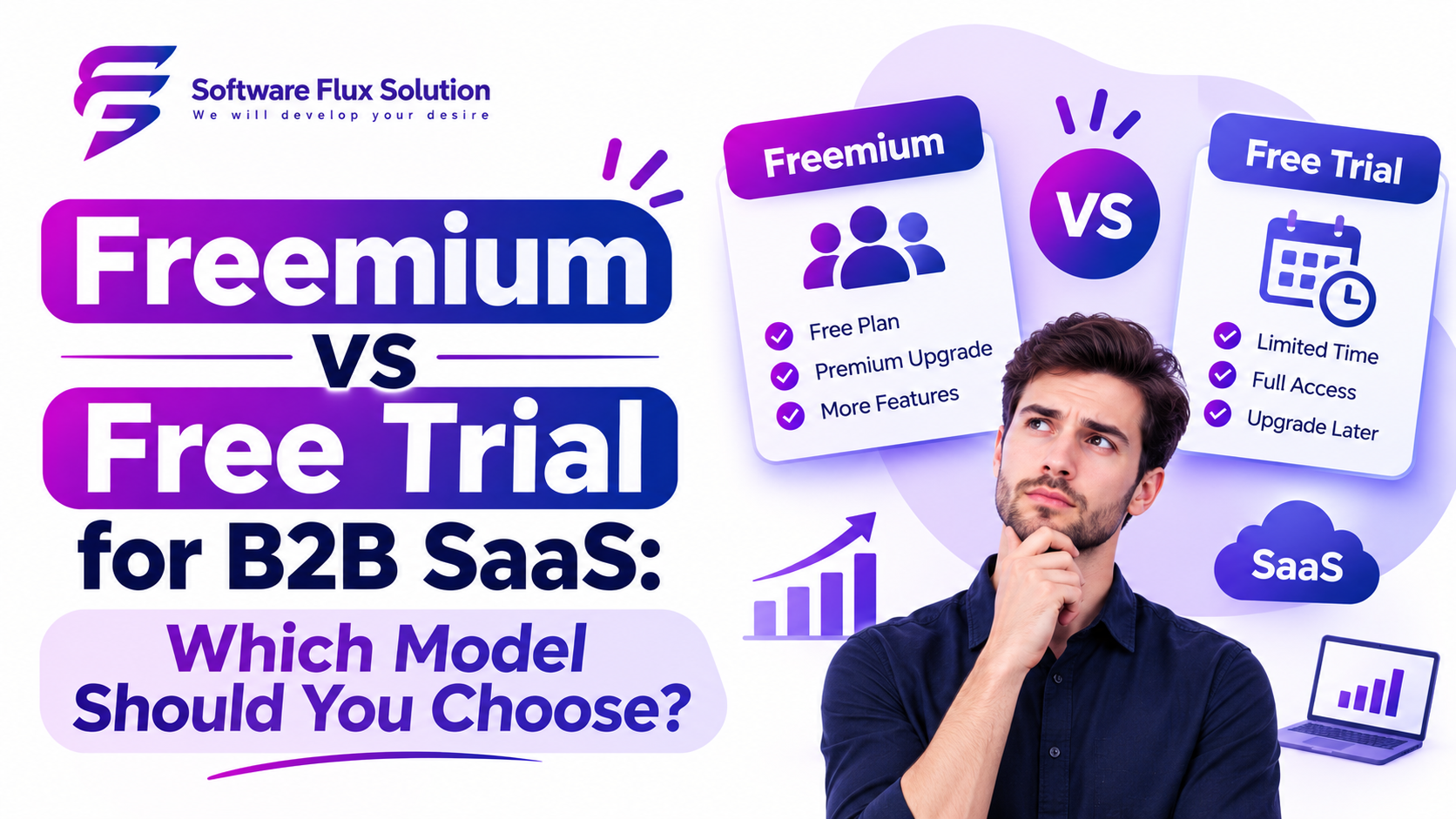
Freemium vs Free Trial for B2B SaaS: Which Model Should You Choose?
You have built a SaaS product. Now you need people to try it. The two most common ways to get users in the door are a free trial and a freemium plan, and choosing the wrong one can quietly hurt your growth for months.
Both models let people experience your product before paying. They work very differently, though, and they suit different products, customers and budgets.
This guide explains how each model works, compares them side by side, walks through the metrics to track, and gives you a practical framework to decide. It also covers hybrid options, such as the reverse trial, and what each model means for your development team.
The Short Answer
- Choose a free trial if your product has a clear “aha moment” that users can reach within days or weeks, your support or hosting cost per user is meaningful, and you sell mainly to businesses with a defined buying process.
- Choose freemium if your product gets better as more people use it (network effects or team collaboration), your cost to serve a free user is low, and a large top-of-funnel is more valuable to you than fast conversion.
- Consider a hybrid if you can’t decide. Many successful products start with a limited free tier and add a time-limited trial of premium features.
What Is a Free Trial?
A free trial gives a user full or near-full access to the product for a fixed period, such as 7, 14 or 30 days. When the period ends, they must pay to continue or lose access.
There are two common versions:
- Opt-in trial (no card required): The user signs up with just an email. This gets more sign-ups, but fewer of them convert, because intent is lower.
- Opt-out trial (card required upfront): The user enters payment details at sign-up and is charged automatically at the end unless they cancel. This gets fewer sign-ups but a higher share of those who start the trial convert to paid. It also carries more risk of complaints about surprise charges, so make the billing terms and the cancellation path very clear.
What Is Freemium?
Freemium gives users a free plan with no time limit, but with restricted features, usage or seats. Users upgrade when they hit those limits or need more advanced capabilities.
Common ways to limit a free plan:
- Usage limits: number of projects, contacts, storage or API calls.
- Feature limits: advanced reporting, integrations or automation reserved for paid plans.
- Seat limits: free for one or a few users, paid for the whole team.
Freemium vs Free Trial: Side-by-Side Comparison
| Factor | Free trial | Freemium |
|---|---|---|
| Time limit | Yes, fixed period | No, ongoing |
| Access level | Often full or near-full | Limited features or usage |
| Sign-up volume | Lower | Higher |
| Urgency to decide | High (deadline) | Low (no pressure) |
| Cost to serve non-paying users | Limited to trial period | Continuous, can grow large |
| Typical conversion rate | Higher share of sign-ups, smaller audience | Lower share of a much larger audience |
| Sales cycle | Shorter | Longer, more gradual |
| Best for | Complex or high-value B2B products | Collaborative, viral or low-cost-to-serve products |
| Main risk | Users leave before reaching value | Users never upgrade |
| Support load | Concentrated during trial | Ongoing |
Pros and Cons of a Free Trial
Advantages
- Creates urgency, which pushes people to actually use the product.
- Lets users experience the full value, including premium features.
- Attracts people with real buying intent, which makes sales follow-up more productive.
- Puts a cap on how much you spend on non-paying users.
Disadvantages
- Users may not have enough time to see value, especially in complex products.
- Fewer sign-ups, so a smaller top of funnel.
- Once the trial ends, you may lose the user for good.
- Requires strong onboarding, because the clock is running.
Pros and Cons of Freemium
Advantages
- Builds a large user base and brand awareness.
- Users can grow into the product at their own pace.
- Free users can bring in teammates, referrals and word of mouth.
- Works well when value increases with usage or team size.
Disadvantages
- Free users cost money in hosting, support and infrastructure.
- Many people stay free forever.
- It is easy to give away too much and weaken the reason to upgrade.
- It can attract the wrong audience, such as people who will never buy.
- Needs a solid analytics setup to spot who is ready to upgrade.
Which Model Fits Your SaaS? A Decision Framework
Answer these six questions honestly.
1. How fast can a new user reach value?
If users get an “aha moment” within minutes or days, a free trial can work well. If value only appears after weeks of setup and data import, a short trial is likely to fail, and you may need either a longer trial, a guided onboarding service, or a freemium plan.
2. What does a free user cost you?
If each free account uses significant compute, storage, third-party API calls or human support, freemium can become expensive. Low marginal cost favours freemium. High marginal cost favours a time-limited trial.
3. Does your product improve with more users?
Products with collaboration, sharing or network effects, such as project tools, design tools and communication apps, benefit from a large free base. Single-user utilities and specialised B2B tools usually do not.
4. Who buys, and how?
If one person can buy with a credit card, both models can work. If purchases need budget approval, security reviews and procurement, a free trial paired with a sales conversation often performs better, because you can guide the buyer through the process.
5. How big is your market?
Freemium needs a large audience. If only a few thousand companies in the world need your product, a high-touch trial is usually a better use of your effort.
6. Can you afford a longer payback period?
Freemium often converts slowly. If you are a young company with limited runway, a trial-based model usually brings revenue sooner.
Quick Scoring Guide
| If most of your answers are… | Lean toward |
|---|---|
| Fast value, high cost per user, high-ticket B2B, niche market | Free trial |
| Slow value discovery, low cost per user, collaborative, large market | Freemium |
| Mixed answers | Hybrid (see below) |
Hybrid Models Worth Considering
You do not have to pick one pure model.
Reverse Trial
New users start with full access to premium features for a limited time. When the period ends, they are moved to a limited free plan instead of being locked out. This lets people experience the full product, while you keep the user in your funnel.
Freemium With Premium Trials
Offer a permanent free plan, and let users try a specific paid feature for a limited time when they hit a related limit or action.
Free Trial With a Fallback Plan
After the trial ends, offer a low-cost starter plan, a pause option or a read-only mode, so the account and its data are not simply lost.
Sales-Assisted Trial
For higher-priced B2B products, pair the trial with a short onboarding call or a guided setup, so users reach value before the trial expires.
Metrics to Track for Either Model
Whatever you choose, measure it. Without data you are guessing.
- Sign-up to activation rate: the share of new users who complete your key first action.
- Time to value: how long it takes to reach the “aha moment”.
- Trial-to-paid or free-to-paid conversion rate: the main outcome metric.
- Time to convert: how many days between sign-up and first payment.
- Product-qualified leads (PQLs): free or trial users whose behaviour shows they are ready to buy.
- Cost to serve free users: infrastructure and support cost per non-paying account.
- Churn in the first 90 days: an early warning on onboarding quality.
- Expansion revenue: upgrades and added seats after conversion.
Benchmark conversion rates vary widely by industry, price point and audience, so use published numbers only as a rough guide and compare against your own history.
Best Practices for Free Trials
- Match the trial length to time to value. If users need two weeks to see results, a 7-day trial is too short.
- Decide on the card upfront question deliberately. Test both if you can.
- Invest in onboarding. Use checklists, templates, sample data and in-app guidance.
- Send behaviour-based emails. Trigger messages by what the user did or did not do, not only by day count.
- Remind before the trial ends, and be transparent about billing.
- Offer a clear next step at the end, such as upgrade, extend, or downgrade.
Best Practices for Freemium
- Limit the right thing. Restrict usage that scales with the customer’s success, such as seats, records or projects, rather than features that make the product feel broken.
- Make the upgrade moment natural. Show the upgrade option when the user hits a limit while doing something valuable.
- Keep free costs under control. Set quotas, rate limits and fair use rules.
- Watch for abuse. Free plans attract spam, scraping and fake accounts, so add verification and monitoring.
- Identify upgrade-ready accounts with usage data and route them to sales or in-app prompts.
What This Means for Your Development Team
The model you choose affects your architecture, so decide it before you build billing and access control.
- Plans and entitlements: build a flexible system where plans, limits and feature flags are configuration, not hard-coded checks.
- Trial state handling: track trial start, end, extension and conversion, and handle time zones and edge cases correctly.
- Billing integration: use a payment provider that supports trials, proration, upgrades and downgrades, and process its webhooks reliably.
- Usage metering: count the actions you limit, such as projects, records or API calls, accurately and in near real time.
- Multi-tenant isolation: make sure limits and data are scoped to each tenant.
- Analytics events: instrument the key activation actions from day one so you can measure what works.
- Downgrade behaviour: decide what happens to data and features when a plan ends, and make it safe and predictable.
Retrofitting these later is usually far more expensive than designing them into the first version.
Common Mistakes to Avoid
- Copying a competitor’s model without checking whether your cost, audience and product match theirs.
- Giving away the core value for free, so there is no reason to upgrade.
- Setting a trial length by habit, such as 14 days, instead of by time to value.
- Ignoring onboarding, which is where most trials are won or lost.
- Not tracking cost per free user.
- Hiding the cancellation path, which creates chargebacks and damages trust.
- Never testing alternatives. Run experiments on length, limits and card requirements.
Frequently Asked Questions
Is freemium better than a free trial?
Neither is better in general. Freemium suits products with low cost to serve, strong collaboration or viral effects and a big market. Free trials suit products with clear fast value, higher prices and focused B2B buyers.
Should a B2B SaaS require a credit card for a free trial?
It depends on your goal. Requiring a card usually reduces sign-ups but raises the share of trial users who convert. Not requiring one grows your top of funnel but needs stronger onboarding and follow-up. Test both if you have enough traffic.
How long should a SaaS free trial be?
Base it on how long it takes a typical user to reach real value, not on a standard number. Simple tools may work with 7 days, while complex platforms may need 14 to 30 days or a guided onboarding.
What is a reverse trial?
A reverse trial gives new users temporary access to premium features, then moves them to a limited free plan when the trial ends. It combines the urgency of a trial with the long-term funnel of freemium.
Can I switch models later?
Yes, but it is harder than most teams expect. Moving from freemium to paid-only can upset existing free users, and adding a free plan later can change how customers see your pricing. Plan your entitlements system so that changing plans and limits is a configuration change, not a rebuild.
What conversion rate should I expect?
It varies too much by product, price and audience to give one reliable number. Track your own baseline, then improve it through onboarding and pricing experiments.
Final Thoughts
The best model is the one that matches your product, your cost structure and your customers. A free trial rewards products that deliver value quickly and sell to focused business buyers. Freemium rewards products that spread through usage and can support a large free base. When you are unsure, start with a hybrid and let your data guide the next step.
Whichever you choose, build the plan, billing and entitlement system so it can change as you learn. If you are planning a new SaaS product and want a platform that supports trials, tiers, usage limits and subscription billing from day one, the team at Software Flux Solution can help. Contact us to discuss your product.

Zainab Bibi
Senior SAAS Project Manager
1+ Years of Experience in SAAS Projects Management