SaaS Application Development: Services, Tech Stack and How to Get Started
Introduction
Deciding to build a SaaS application is a significant commitment. It is not just about writing code, it involves architecture decisions, infrastructure choices, security requirements, and ongoing product evolution. Understanding what SaaS application development entails before you start will save you months of rework and significant budget.
This article covers everything from what SaaS application development services include to which technology stacks are used by leading SaaS companies, and what to look for when evaluating a development partner.
What Is SaaS Application Development?
SaaS application development is the process of building, deploying, and maintaining software that is hosted in the cloud and accessed by users over the internet on a subscription basis. Unlike a website or a traditional desktop app, a SaaS application must be designed from the start for multi-tenancy, continuous deployment, and elastic scale.
A fully developed SaaS application includes a frontend interface, a backend API, a database layer, authentication and authorization systems, billing and subscription management, and the cloud infrastructure to host it all.
Core SaaS Application Development Services
Product Discovery and Architecture Planning
Before a single line of code is written, a thorough discovery process defines what the application needs to do, who it serves, and how it should be architected. This includes selecting the data model, defining tenant isolation strategy, and choosing the right cloud platform.
Frontend Development
The frontend is what users interact with. Modern SaaS frontends are typically built with React, Vue.js, or Next.js, designed to be fast, accessible, and responsive across devices. Great SaaS products invest heavily in frontend quality, it is what users judge the product by.
Backend API Development
The backend handles business logic, data processing, and integrations. Most modern SaaS backends are built API-first using frameworks like Node.js with Express, Django (Python), Ruby on Rails, or Laravel (PHP). The API layer communicates with the database and exposes endpoints for the frontend and any third-party integrations.
Database Design and Management
SaaS applications typically rely on both relational databases (PostgreSQL, MySQL) for structured data and NoSQL databases (MongoDB, DynamoDB) for flexible or high-volume data. The schema must support multi-tenancy while keeping query performance high.
Authentication and Security
Every SaaS application needs robust authentication. This includes user registration, login, password management, multi-factor authentication (MFA), and often enterprise SSO via SAML or OAuth2. Security is non-negotiable, a data breach in a multi-tenant system can expose all of your customers.
Subscription and Billing Integration
Integrating subscription billing, typically via Stripe or Chargebee, is a standard part of SaaS app development. This covers plan creation, payment processing, invoice generation, proration for plan changes, and handling failed payments and dunning.
Cloud Infrastructure and DevOps
SaaS applications are deployed to cloud platforms: AWS, Azure, or Google Cloud. A proper DevOps setup includes containerization (Docker, Kubernetes), CI/CD pipelines, environment management (staging, production), monitoring, and alerting.
Third-Party Integrations
Most SaaS products need to connect to other tools, CRM systems, email providers, analytics platforms, payment gateways, or communication APIs like Twilio and SendGrid. API-first architecture makes these integrations cleaner and more maintainable.
Common SaaS Tech Stacks
The MERN Stack (MongoDB, Express, React, Node.js)
One of the most popular stacks for SaaS applications. JavaScript across the full stack means a smaller team can cover both frontend and backend. MongoDB’s flexible schema suits early-stage products where the data model is still evolving.
Next.js + PostgreSQL + AWS
A production-grade stack for SaaS products that need strong SEO, server-side rendering, and a reliable relational database. Widely used by B2B SaaS companies.
Django + React + Google Cloud
Python-powered backend with a React frontend. Popular in data-heavy SaaS applications, AI-powered products, and anything that leans on Python’s ecosystem of libraries.
Ruby on Rails + PostgreSQL + Heroku or AWS
Rails is still one of the fastest ways to build a SaaS MVP. The convention-over-configuration philosophy and mature gem ecosystem mean less time reinventing the wheel.
Phases of SaaS App Development
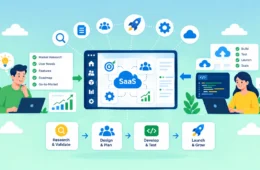
A professional SaaS application development engagement typically follows these phases:
Discovery: defining requirements, target users, and the technical approach
- Design: UI/UX wireframes and architecture blueprints
- Development: agile sprints delivering working software incrementally
- QA and testing: automated tests, performance testing, and security audits
- Launch: deployment to production with monitoring in place
- Post-launch: feature iteration, scaling, and ongoing support
How to Get Started with SaaS App Development
If you are ready to build your SaaS application, here is how to approach it:
Step 1, Define the problem clearly: What specific pain point are you solving? Who is your target customer, and what does their current workflow look like without your product?
Step 2, Validate before you build: Talk to potential customers. A landing page, a demo, or a prototype can confirm demand before you invest in full development.
Step 3, Plan your MVP: Identify the minimum feature set that delivers real value to early users. Resist the urge to build everything at once.
Step 4, Choose a development approach: In-house team, freelancers, or a SaaS development company. Each has trade-offs, consider your budget, timeline, and how hands-on you want to be.
Step 5, Select your stack: Choose a tech stack your team knows well, or that your development partner recommends based on your requirements.
Step 6, Build, learn, and iterate: Launch your MVP, gather real user feedback, and iterate rapidly. The best SaaS products improve continuously.
Working with a SaaS Application Development Company
Partnering with an experienced SaaS application development company gives you access to a team that has solved these problems before. At Software Flux Solutions, our SaaS app development team includes product managers, cloud architects, full-stack developers, QA engineers, and DevOps specialists, everything you need to go from idea to launch.
We have delivered SaaS products for clients in healthcare, HR tech, e-commerce, FinTech, and EdTech. Every engagement starts with a discovery session, not a quote.
Have questions or ready to get started? Contact us and our team will guide you through every step of the process.
Conclusion
SaaS application development is a multi-disciplinary effort that goes well beyond writing code. Getting the architecture right, choosing the right services and tools, and having a clear development process are what separate successful SaaS launches from expensive pivots. Start with a clear problem, a realistic MVP, and a team that has done this before.

Zainab Bibi
Senior SAAS Project Manager
1+ Years of Experience in SAAS Projects Management