What Is SaaS Development? A Complete Guide for Startups and Businesses
Software-as-a-Service, SaaS, has become the dominant delivery model for modern business software. From the tools your team uses to communicate to the platforms you rely on to run payroll, the chances are most of them are SaaS products. But what exactly is SaaS development, and what does it take to build one?
This guide breaks down SaaS development from the ground up: what it means, how it works, why businesses are investing in it, and what you need to know before starting your own SaaS project.
What Is SaaS?
SaaS stands for Software as a Service. Unlike traditional software that users install on their own hardware, SaaS products are hosted in the cloud and accessed over the internet, typically through a web browser or mobile app. The vendor manages the infrastructure, the servers, the updates, and the security. The user just logs in and gets to work.
Familiar examples include Slack, Shopify, Salesforce, Zoom, and HubSpot. Every one of these is a SaaS product built on cloud infrastructure, delivered to thousands or millions of users simultaneously.
What Is SaaS Development?
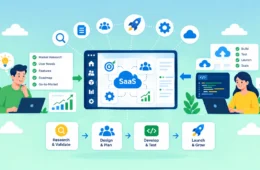
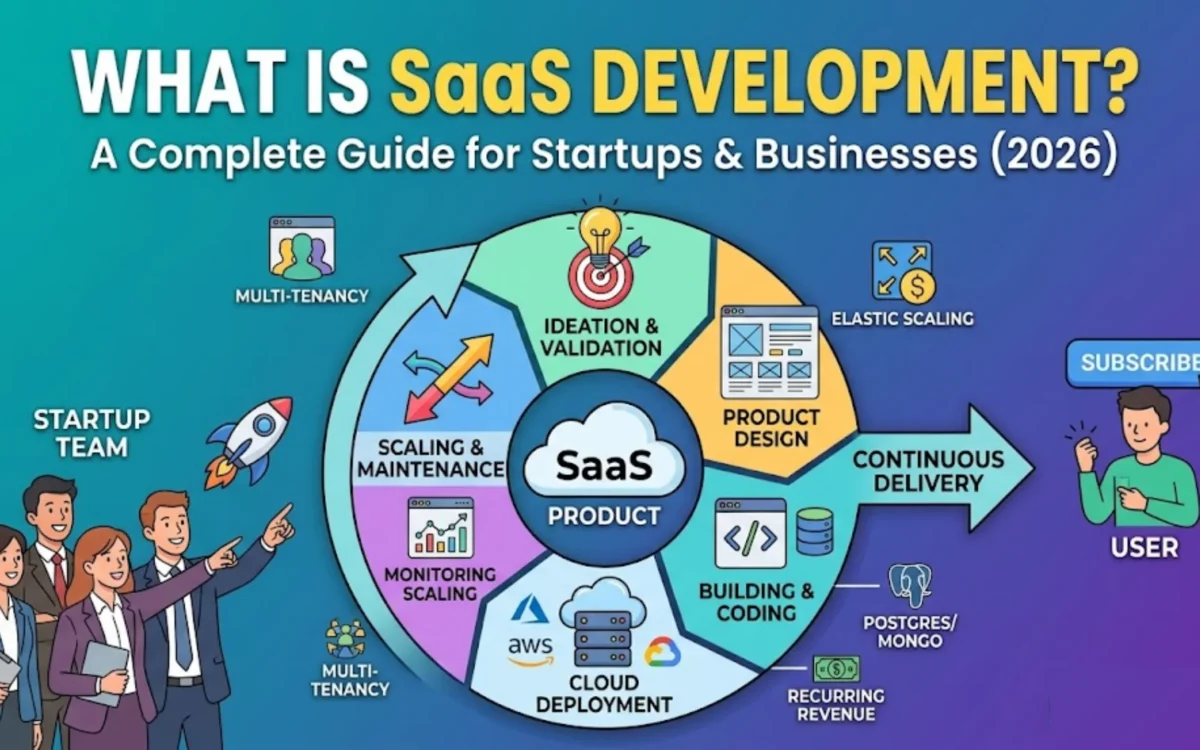
SaaS development is the end-to-end process of designing, building, deploying, and maintaining a software product delivered as a service over the cloud. It encompasses everything from defining what the product does and who it is for, to writing the code, setting up the infrastructure, and continuing to evolve the product after launch.
- SaaS development differs from building a traditional software application in several important ways:
- Multi-tenancy: a single application instance serves many customers simultaneously, with data kept isolated between them.
- Continuous delivery: SaaS products are never truly finished. They are updated constantly, often weekly or daily.
- Subscription monetization: SaaS products typically generate revenue through recurring subscriptions rather than one-time purchases.
- Cloud-native infrastructure: SaaS products are built to run on cloud platforms like AWS, Azure, or Google Cloud, making scaling elastic rather than dependent on physical hardware.
Why Businesses Invest in SaaS Development
The business case for SaaS is compelling from both sides of the market.
For end users and businesses buying SaaS:
- No installation or maintenance required
- Predictable monthly or annual costs
- Access from anywhere on any device
- Automatic updates and security patches
For founders and companies building SaaS:
- Recurring revenue creates predictable, compounding income
- One codebase serves all customers, reducing support overhead
- Easy to scale to new markets without rebuilding the product
- Data from user behavior drives continuous product improvement
Core Concepts Every SaaS Builder Should Know
Multi-Tenancy
The architecture that allows one application to serve many customers. Each customer (tenant) sees their own data and configuration, but the underlying code and infrastructure are shared. This is fundamental to the economics of SaaS, it keeps your operating costs low as you scale.
API-First Design
Modern SaaS products are built API-first, meaning the backend is structured as a set of APIs that the frontend consumes. This makes it easier to build mobile apps, integrate with third-party tools, and create partner ecosystems.
Subscription Billing
SaaS monetization relies on recurring billing. Most products use monthly or annual plans, often tiered by usage volume, feature access, or number of seats. Tools like Stripe make it possible to implement sophisticated billing without building it from scratch.
Cloud Infrastructure
SaaS products run on cloud platforms, AWS, Azure, or Google Cloud, that provide compute, storage, databases, and networking on demand. This is what makes elastic scaling possible.
How to Learn SaaS Development
If you are a developer looking to break into SaaS development, the learning path combines software engineering fundamentals with SaaS-specific knowledge:
- Master a backend language: Node.js, Python, Ruby on Rails, or Go are all common in SaaS stacks.
- Learn cloud fundamentals: AWS, Azure, or Google Cloud certifications are increasingly expected.
- Understand database design: both relational (PostgreSQL) and NoSQL (MongoDB) databases are widely used.
- Study SaaS architecture patterns: multi-tenancy, event-driven architecture, and microservices.
- Practice with real projects: build a small SaaS product to apply what you learn.
What Does It Take to Build a SaaS Product?
Building a SaaS product requires a combination of product thinking, engineering depth, and business strategy. The most common components include:
- A clear problem worth solving and a defined target customer
- A technical architecture that supports multi-tenancy and scaling
- Frontend and backend development (and a mobile layer if needed)
- Authentication, authorization, and security infrastructure
- Subscription billing and payment processing
- DevOps and deployment pipelines
- Monitoring, logging, and analytics
Should You Build In-House or Work with a SaaS Development Company?
This is one of the most common decisions early-stage founders face. Building in-house gives you complete control and ownership, but requires finding and retaining engineering talent, which is expensive and competitive.
Working with a SaaS development company like Software Flux Solutions gives you access to a full team of product managers, architects, developers, and QA engineers from day one, at a fraction of the cost of hiring internally. For startups and SMEs, this is often the faster and more capital-efficient path to launch.
Conclusion
SaaS development is both a technical discipline and a business strategy. Building a successful SaaS product requires getting the architecture right, choosing the right tools, and having a clear plan for how your product will grow. Whether you are a solo founder or an enterprise team, understanding the fundamentals covered in this guide is the essential first step.
Want to discuss your SaaS idea with a team that has built over 300 products? Get in touch with Software Flux Solutions.

Zainab Bibi
Senior SAAS Project Manager
1+ Years of Experience in SAAS Projects Management