Custom CRM Web Development vs Off-the-Shelf: What Actually Works for B2B Companies
The CRM Adoption Problem Nobody Talks About
CRM adoption rates are notoriously poor. Studies consistently show that 40–60% of CRM implementations fail to achieve their intended adoption targets within 12 months. The blame often falls on users, “salespeople don’t want to enter data.” But the deeper truth is that off-the-shelf CRMs are built for the median sales workflow, not your sales workflow. When your process differs significantly from the assumed model, users work around the CRM instead of through it. Custom CRM web development solves this by building a system that mirrors the actual way your team sells. At Software Flux Solution, we’ve delivered custom CRM platforms for B2B companies in professional services, manufacturing, logistics, and SaaS, each with unique pipeline logic, data relationships, and reporting requirements that Salesforce simply couldn’t accommodate without six-figure implementation costs.
When Off-the-Shelf CRM Is the Right Answer
Before advocating for custom development, it’s worth being honest about when Salesforce, HubSpot, or Pipedrive is the better choice. If your sales process is close to standard, leads, opportunities, deals, contacts, and you have fewer than 50 salespeople, you should strongly consider a well-configured off-the-shelf option first. The mature ecosystem means faster implementation, better integrations with marketing tools, and no engineering maintenance burden. The inflection points where custom CRM development starts making economic sense are: when off-the-shelf licensing costs exceed $3,000/month, when you’ve spent more than 200 hours customising a platform and still have major workflow gaps, when your CRM needs to deeply integrate with proprietary ERP or industry software, or when your data model involves non-standard objects that platforms handle awkwardly. Our Website Development team can help you evaluate this threshold honestly before you commit to a build.
Core Modules Every Custom CRM Web Application Needs
A custom CRM built for serious B2B sales must include:
- Contact and account management with flexible custom field support and relationship mapping (contacts belong to accounts, accounts belong to territories, etc.)
- Pipeline management with configurable stages, probability weighting, and stage transition rules (e.g., “opportunity cannot move to Proposal without a discovery call logged”)
- Activity tracking: calls, emails, meetings, tasks, with two-way email sync (Gmail and Outlook) and calendar integration
- Reporting and analytics: pipeline by stage, velocity, win/loss analysis, rep leaderboards, and forecast rollups
- Role-based access: SDRs see only their own accounts, managers see their team, executives see everything
- Integration layer: webhooks and API endpoints for marketing automation, ERP, and customer success tools
These modules represent the non-negotiable foundation. Your competitive advantage in CRM development comes from the custom logic layered on top, the commission calculation engine, the territory assignment algorithm, the custom approval workflow. Explore our SaaS Development capabilities to see how we build these complex business rule engines.
Database Design for CRM: Getting the Relationships Right
CRM data modelling is deceptively complex. The standard CRM data model (Contacts → Accounts → Opportunities → Activities) breaks down quickly when real-world complexity enters. B2B companies frequently deal with: one contact belonging to multiple accounts (a consultant), multiple decision-makers influencing a single deal (buying committee mapping), subsidiary relationships between accounts, partner-sourced vs direct deals requiring attribution tracking, and long-running contracts that spawn renewals and upsell opportunities. Getting these relationships right at the schema level, before any code is written, is the single most important decision in CRM development. A poorly designed data model forces years of workarounds. Our About Us engineering team conducts data modelling workshops before every CRM project to map these relationships explicitly.
Custom Dashboards and Reporting: The Real Value Proposition
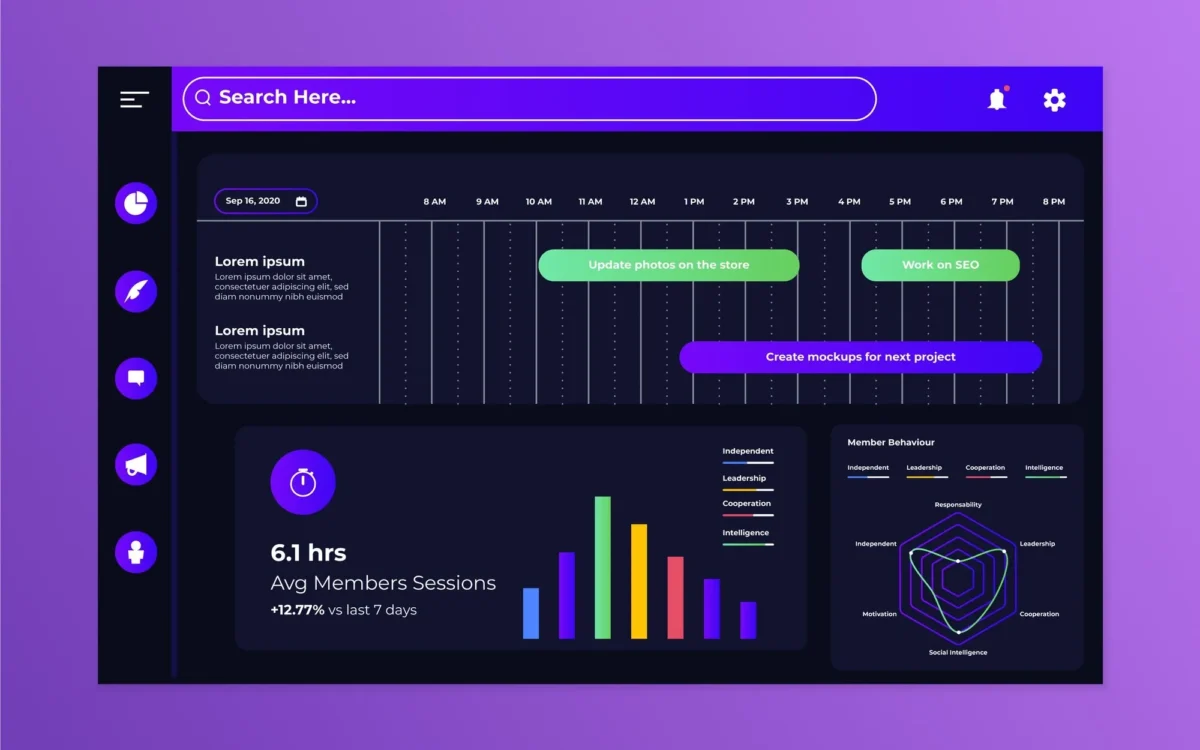
The #1 reason B2B executives want custom CRM development is reporting. Off-the-shelf platforms offer dashboards, but they’re constrained by the platform’s data model. A custom CRM can expose any aggregation, any time slice, any combination of dimensions that management actually uses to run the business. Real-time pipeline visibility, cohort-based close rate tracking, multi-touch attribution across SDR and AE handoffs, forecast variance analysis, these are the reports that justify the CRM budget. We build reporting layers on top of PostgreSQL’s excellent window function support, with pre-computed materialised views for expensive aggregations and live queries for real-time pipeline views. See examples of the dashboards we’ve built in our Our Work section.
Integration Architecture: CRM as the Source of Truth
A custom CRM only delivers its full value when it’s the authoritative source of truth across your go-to-market stack. This means building robust bidirectional integrations with: your marketing automation platform (HubSpot Forms, Marketo, or custom lead capture), your customer success tool (passing CRM data on renewal risk indicators), your ERP or invoicing system (so closed deals automatically create contracts), your support ticketing system (so account managers see open tickets), and your product analytics (so sales knows which features trial users have adopted). These integrations are most reliably built as an event-driven architecture using a message queue (Redis or RabbitMQ), ensuring no data is lost if a downstream system is temporarily unavailable. Contact Us our team to discuss integration architecture for your CRM project.
Build Timeline and Cost Reality
A custom CRM web application built to production quality, not a prototype, takes 12 to 20 weeks for a core module set and costs significantly more than a year of Salesforce Enterprise licenses. The ROI calculation must account for: elimination of per-seat licensing, removal of expensive consultants needed to configure and extend the platform, faster user adoption (teams actually use tools built for their workflow), and the strategic value of owning your own customer data infrastructure. For companies with 20+ salespeople spending significant time working around CRM limitations, the break-even point is typically 18 to 24 months. Visit Our Services for a full overview of how we scope and price custom web development projects, or Contact Us us directly for a discovery call.

Zainab Bibi
Senior SAAS Project Manager
1+ Years of Experience in SAAS Projects Management