When Custom Application Development Is the Right Choice
What Is Custom Application Development?
Custom application development is the process of designing, building, and deploying software created specifically for one organisation’s workflows, rather than configuring a pre built product designed for a broad market. Unlike off the shelf tools, which require a business to adapt its process to fit the software, a custom application is shaped entirely around how the business actually operates, its data structures, its approval chains, its compliance obligations, and its customer experience.
Analysts project continued double digit annual growth for the custom and enterprise software development market through the end of the decade (one widely cited estimate puts the global custom development market at over $146 billion by 2030, growing at roughly 22% a year), driven by businesses that have outgrown generic tools and need software matched to their exact operational reality rather than a vendor’s assumptions about it.
This guide covers when custom development is the right call, what it costs, how the process works, what types of custom applications businesses build, and what to look for in a development partner.
Your Workflows Cannot Fit Existing Products Without Heavy Workarounds
If your team exports data to spreadsheets because your software cannot handle your actual process, re-enters information across multiple systems, or spends meaningful time managing tool limitations rather than doing the work itself, that is a direct cost that compounds every month. When those workaround costs exceed the cost of building properly, custom development is the financially rational decision.
You Operate in a Regulated Industry Where Compliance Must Be Architectural
Healthcare organisations subject to HIPAA, financial services firms navigating SOC 2 and PCI-DSS requirements, and any organisation subject to GDPR cannot afford to rely on a vendor’s compliance posture. Custom application development allows you to build security controls, audit trails, data residency requirements, and access management into the application architecture from day one rather than attempting to configure a general product to meet requirements it was not specifically designed for.
You Need Deep Integration With Existing or Legacy Systems
Many established businesses run on ERP platforms, proprietary databases, or supply chain systems that predate modern API standards. When those systems are business-critical but cannot connect cleanly with modern tools, a custom application can serve as the integration layer that unifies the data landscape without requiring you to replace infrastructure that works.
Licensing Costs Will Exceed Build Cost Within Three to Five Years
This requires honest arithmetic. Calculate current and projected per-seat licensing fees, add-on module costs, and the labour cost of workarounds. Compare this against the total cost of owning a custom application including maintenance. For organisations with significant user counts or complex module requirements, the crossover point frequently arrives within three years, sometimes sooner.
The Software Is Central to Your Competitive Differentiation
When the application you need is what makes your business different your pricing logic, your customer experience, your operational efficiency, building it on the same platform your competitors can simply subscribe to means competing on execution alone. Custom development allows you to encode proprietary processes and institutional knowledge into software that competitors cannot replicate by purchasing the same subscription.
When Off-the-Shelf Software Remains the Better Choice
Custom application development is genuinely not right for every situation, and a reliable development partner should tell you so honestly.
If your requirement is a standard business function that dozens of established products already handle well basic CRM, straightforward project management, standard accounting, the implementation cost, timeline, and ongoing maintenance burden of a custom build rarely justifies the investment when capable existing products serve the need adequately.
If your team is small without dedicated technical resources or budget to manage ongoing maintenance, a SaaS product with built-in vendor support is a more realistic operational choice. Custom applications require stewardship, security patches, performance monitoring, compatibility updates, and feature evolution that demands either internal capacity or a development partner relationship.
If you need a functional solution within weeks rather than months, off-the-shelf is the right starting point. A well-scoped custom application MVP takes a minimum of three to four months from discovery to launch, and more comprehensive platforms take six to twelve months or longer.
Custom Application Development vs Off-the-Shelf Software at a Glance
| Factor | Custom Application | Off-the-Shelf Software |
|---|---|---|
| Fit to your workflow | Built around your exact process | You adapt your process to the tool |
| Upfront cost | Higher | Lower |
| Ongoing cost | Maintenance and hosting, no license fees | Recurring subscription that scales with seats |
| Ownership | You own the code and data outright | Vendor owns the platform, you rent access |
| Time to launch | Months | Days to weeks |
| Compliance control | Built into the architecture | Limited to what the vendor allows you to configure |
| Competitive advantage | Encodes processes competitors cannot copy | Same tool available to any competitor |
Types of Custom Applications
Custom application development covers a wide range of software categories, each solving a different operational problem. The types businesses ask us to build most often include:
- Enterprise Resource Planning (ERP) systems that unify finance, inventory, procurement, and HR data into a single platform built around your specific chart of accounts and approval structure.
- Custom CRM platforms that manage sales pipelines, referral tracking, or client relationships in ways a general purpose CRM cannot, particularly where industry compliance rules affect what data can be stored and how.
- Internal workflow and process automation tools that replace manual approval chains, spreadsheet handoffs, and email based requests with a structured, auditable system.
- Custom dashboards and reporting tools that pull data from multiple existing systems into a single real time view matched to the KPIs a specific team actually tracks.
- Client facing portals that give customers or partners self service access to their own data, documents, or order status without exposing internal systems.
- Ticketing and issue tracking systems used by support, IT, or operations teams to log, prioritise, and resolve requests against service level commitments.
- Compliance and audit management tools that generate the documentation, approval trails, and access logs required by regulators in healthcare, finance, and other regulated sectors.
- Learning and training platforms built around a specific curriculum, certification structure, or workforce onboarding process rather than a generic course library.
Most businesses that approach us for custom application development are looking for one of these categories, though many projects combine two or three, a client portal built on top of a custom workflow engine, for example.
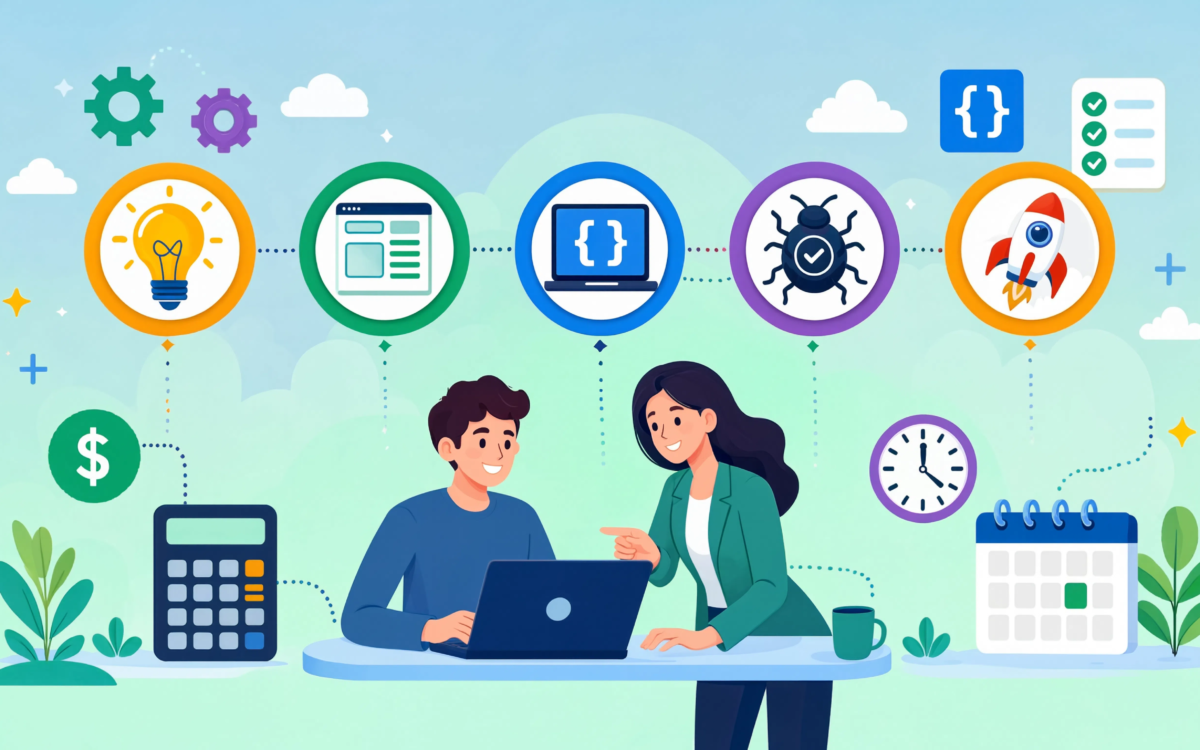
The Custom Application Development Process
A well-run custom application development project follows a structured sequence where each phase builds on the previous. Understanding this sequence protects businesses from the most common source of budget overruns: inadequate upfront planning.
Discovery and Requirements Gathering
This is the phase most organisations underinvest in and most strongly predicts project outcome. Stakeholder interviews, process mapping, user research, and documented requirements specification happen before any design or development work begins. Projects that skip or compress discovery consistently cost more in total than projects with thorough discovery, because misunderstandings caught during requirements gathering cost a fraction of what they cost to fix mid-development or post-launch.
Solution Architecture and Technical Design
The technical foundation gets designed here, technology stack selection, database architecture, integration strategy for third-party systems, security model, and cloud infrastructure approach. These decisions have compounding consequences throughout the application’s life and deserve the investment of senior technical thinking rather than default choices.
UX and Interface Design
Wireframes establish structure and user flow before any visual design work begins, enabling low-cost feedback on information architecture before the higher-cost visual and development investment follows. Polished interface designs, validated with actual intended users rather than project stakeholders alone, significantly reduce costly revisions during development.
Iterative Development
Development proceeds in structured sprints, typically two weeks each, with working software demonstrated at the end of every sprint. This approach surfaces misalignments early, while changes are still straightforward to make, rather than discovering them only at a single large delivery milestone months after the original decision was made.
Quality Assurance and Testing
Testing covers functional correctness across all user roles and data states, performance under realistic usage volumes, security vulnerability assessment, and cross-device and cross-browser compatibility. Applications handling sensitive data require additional compliance testing. The cost of addressing issues found during testing is a fraction of the cost of fixing the same issues in production.
Deployment and Training
Production deployment includes data migration from existing systems, environment configuration, integration testing in the live environment, and user training sufficient to ensure confident adoption from day one rather than a period of confusion that undermines the initial perception of the new system.
Ongoing Support and Evolution
An application without ongoing investment is a depreciating asset. Operating system updates, browser changes, security patches, and the natural evolution of business requirements mean post-launch development is not optional, it is part of owning software. The organisations that treat their custom application as a continuously improving product consistently extract more value from their initial investment than those who treat launch as the endpoint.
What Custom Application Development Costs
Cost depends on application complexity, but realistic ranges prevent the shock that hits businesses who receive their first proposal without any prior calibration.
| Application Type | Typical Cost Range | Typical Timeline |
|---|---|---|
| Focused internal tool (single workflow, limited users) | £20,000 to £50,000 | 10 to 16 weeks |
| Moderately complex application (multiple user roles, integrations) | £50,000 to £120,000 | 4 to 7 months |
| Complex enterprise platform (extensive functionality, multiple integrations, scale requirements) | £120,000 and above | 7 to 12+ months |
Understanding Total Cost of Ownership
The build cost is the beginning of the investment, not the entirety of it. Ongoing costs include hosting and cloud infrastructure (typically 15 to 20% of build cost annually), maintenance and security patching, feature development based on real usage data, and periodic compliance audits for regulated industries.
A practical five-year comparison: a custom application costing £100,000 to build with £20,000 per year in maintenance represents a five-year total cost of £200,000, with full data ownership and no vendor dependency. A SaaS alternative at £40,000 per year represents £200,000 over the same period with no ownership at the end, and the risk of pricing changes, feature removal, or vendor decisions affecting your operations at any point.
Custom Application Development by Industry
Healthcare
Healthcare custom applications manage patient records, appointment scheduling, clinical documentation, telehealth consultation, and compliance with data protection requirements specific to medical information. The requirement for built-in compliance rather than configured compliance makes custom development particularly valuable in this sector.
Financial Services
Financial sector applications require custom logic for risk management, transaction processing, fraud detection, regulatory reporting, and compliance documentation. The precision required for financial data handling and the regulatory scrutiny applied to financial technology systems makes bespoke development common at all market segments.
Construction and Field Operations
Construction companies use custom platforms to manage project scheduling, subcontractor coordination, site inspections, compliance documentation, and financial reporting across multiple simultaneous projects. Our work in SaaS Development for Construction Companies covers the specific operational requirements this sector presents that generic project management tools consistently fail to address.
Healthcare CRM and Patient Management
Beyond clinical applications, healthcare organisations use custom CRM platforms to manage patient relationships, referral tracking, and communications in ways that general purpose CRM platforms cannot handle within the compliance and data sensitivity constraints of the sector. Our Healthcare CRM Development practice addresses this specific requirement directly.
Events and Platform Businesses
Event management platforms and marketplace businesses have operational requirements that standard software cannot serve ticketing architecture, split payment systems, exhibitor management, and real-time availability management. These are covered in our Event Management Platform Development and Marketplace Development Company services respectively.
How to Choose the Right Custom Application Development Partner
Evaluating development partners specifically rather than proposals is the discipline that most strongly predicts project success.
Assess relevant domain experience. A partner with direct experience in applications of comparable complexity and regulatory context to yours surfaces domain-specific requirements early that a generalist team discovers mid-project. Our SaaS development services span multiple industry verticals precisely because this contextual knowledge accelerates delivery and reduces avoidable mistakes.
Require direct access to technical team members. The team who will build your application should be part of the evaluation process, not only the account management layer. Architecture questions asked directly of the people who will make those decisions reveal capability more accurately than any portfolio review.
Evaluate process clarity specifically. Ask how the partner handles requirements that change once development is underway. Ask how frequently you will see working software during development. Ask what their approach is to documentation of decisions made during the project. Partners with mature delivery processes answer these questions specifically. Those without robust processes offer reassurance instead of specifics.
Verify references from comparable projects. Contact previous clients and ask specifically how the partner handled unexpected challenges during delivery, whether the final product performed as promised in the commercial process, and whether they would engage the same partner again. These conversations reveal the delivery experience rather than the sales experience.
Confirm intellectual property terms explicitly. All code, documentation, and assets produced during the engagement should belong to you upon delivery and payment. This should be unambiguous in the contract before any work begins.
For businesses in the UK specifically, the custom software application development expertise available in the market has been shaped by sustained demand from financial services, legal technology, and enterprise software sectors that have required sophisticated, compliance-aware applications for longer than most comparable markets. This accumulated depth is worth factoring explicitly into partner evaluation.
Frequently Asked Questions
What is custom application development?
Custom application development is the process of designing, building, and deploying software created specifically for one organisation’s exact workflows and requirements, rather than using a pre-built product designed for broad market use.
What is a custom application software?
Custom application software is a software program built specifically for a single organisation or use case, rather than sold as a general product available to multiple businesses. The organisation that commissions it typically owns the source code, data, and full product roadmap.
What does “custom application” mean?
A custom application is a software program built to specification for a specific business, rather than a standard product purchased off the shelf. Custom means the features, architecture, user experience, and integrations are determined by the commissioning organisation’s requirements rather than a vendor’s product decisions.
What is a custom software development?
Custom software development is the practice of building software from a defined specification for a specific client or organisation. It covers the full process from requirements gathering and design through to development, testing, deployment, and ongoing maintenance.
How much does custom application development cost?
Cost ranges from £20,000 for a focused single-workflow tool to £120,000 and above for complex enterprise platforms with multiple user roles and integrations. The primary cost drivers are feature scope, number of user roles, integration complexity, and compliance requirements.
How long does custom application development take?
A focused MVP typically takes 10 to 16 weeks from discovery through to launch. Moderately complex applications take four to seven months. Complex enterprise platforms take seven to twelve months or longer depending on scope and integration requirements.
When should a business choose custom development over off-the-shelf software?
Custom development makes the most sense when your workflows cannot be adequately served by existing products, when your industry requires compliance built into the architecture rather than configured onto a generic platform, when you need deep integration with proprietary or legacy systems, or when the software represents a genuine competitive differentiator rather than commodity infrastructure.
What is the difference between custom application development and customising an existing platform?
Customising an existing platform means configuring or extending a product someone else built within the boundaries they define. Custom application development means building from scratch to your exact specification. The distinction matters because configuring an existing platform leaves you dependent on that vendor’s decisions, pricing, and roadmap, while a custom build gives you complete ownership and control.
Starting Your Custom Application Project
If your organisation is evaluating whether custom application development is the right investment for a specific operational challenge, the starting point is a structured discovery conversation rather than a development proposal.
A discovery engagement maps your actual workflows, documents your requirements, identifies the integration landscape, and produces a realistic scope and cost estimate before any development commitment is made. This investment in clarity consistently pays back many times over in avoided mid-project surprises and final products that genuinely match the original business need.
Contact our team to discuss your specific requirements. We will help clarify whether custom application development is genuinely the right approach for your situation before any commercial conversation begins. Alternatively, visit our SaaS development services page for a broader overview of our technical capabilities across different application types and industries.

Zainab Bibi
Senior SAAS Project Manager
1+ Years of Experience in SAAS Projects Management