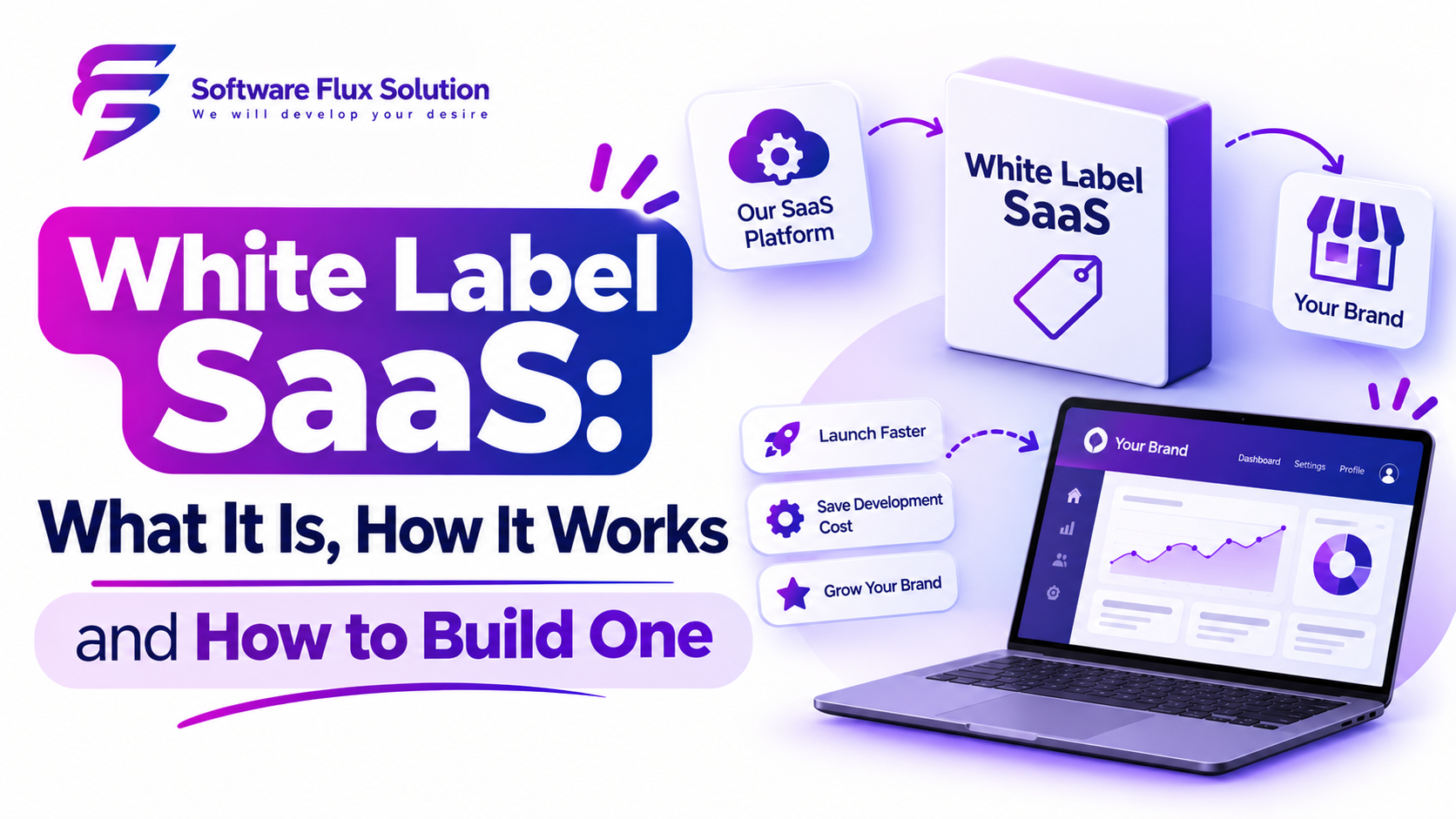
White Label SaaS: What It Is, How It Works and How to Build One
Building a SaaS product from scratch takes months of development and a lot of money. Selling it takes even longer. White label SaaS offers a shortcut: one company builds the software, and other companies sell it under their own brand.
For the company that built it, white labeling opens a new sales channel. For the company that sells it, it is a way to launch a software product without hiring a development team.
This guide explains what white label SaaS is, how it differs from similar models, what it costs and earns, and the technical features you need if you want to build a white label product of your own.
What Is White Label SaaS?
White label SaaS is software built by one company (the provider) that another company (the reseller or partner) rebrands and sells as its own. Customers see the reseller’s name, logo, colors and domain. They usually have no idea who built the software underneath.
A simple example: a marketing agency wants to offer clients a reporting dashboard. Instead of building one, it licenses a white label reporting platform, adds its own logo and domain, and sells it to clients as “Agency Name Analytics.”
The three players
- The provider builds, hosts and maintains the software.
- The reseller (or partner) brands it, markets it, prices it and supports the customer relationship.
- The end customer uses the product under the reseller’s brand.
White Label vs Private Label vs Reseller vs OEM
These terms are often mixed up. Here is how they differ in practice.
| Model | What it means | Branding | Customization | Typical use |
|---|---|---|---|---|
| White label | Ready-made software rebranded by the reseller | Reseller’s brand | Limited to branding and settings | Quick launch, low cost |
| Private label | Software built or tailored exclusively for one brand | Reseller’s brand | Often deep, sometimes exclusive | Brand wants control and exclusivity |
| Reseller program | Reseller sells the provider’s product, usually under the provider’s brand | Provider’s brand | Minimal | Sales partnerships |
| OEM | Provider’s software is embedded inside another company’s product | Often hidden | Technical integration | Software platforms and hardware |
The lines blur between white label and private label, and companies use the words differently. The practical question is always: who controls the brand, the roadmap and the customer relationship?
How White Label SaaS Works
- The provider builds a multi-tenant platform that can serve many separate customers from one codebase.
- A partner signs up and gets an admin account, often with a partner dashboard.
- The partner configures their brand: logo, colors, custom domain, email sender, product name and sometimes the language.
- The partner creates or invites customer accounts, often through their own sign-up and billing flow.
- Customers use the product under the partner’s brand and pay the partner.
- The partner pays the provider under the agreed model, such as a flat fee, per-seat fee, revenue share or usage-based charge.
- The provider maintains the platform, shipping updates and fixes to all partners at once.
Benefits of White Label SaaS
For the reseller
- Fast launch. You can go to market in weeks instead of building for a year.
- Lower upfront cost. No development team, no infrastructure to design.
- New revenue stream. Add recurring software revenue to a service business.
- Stronger brand and retention. Your clients use your branded tool every day.
- Control over pricing. You set your own prices and margins.
For the provider
- A new sales channel. Partners bring customers you may never reach directly.
- Lower acquisition cost. Partners do the marketing and sales.
- Scale from one codebase. One product, many brands.
- Predictable revenue from partner subscriptions or revenue share.
Drawbacks and Risks
For the reseller
- Dependence on the provider. If the provider shuts down, raises prices or changes the product, you are exposed.
- Limited differentiation. Other resellers may sell the same product with a different logo.
- Limited control over the roadmap. You cannot always get the features you want.
- Support responsibility. Customers call you, even when the problem is in the provider’s software.
- Data and compliance questions. You need clarity on where data lives and who is responsible for security.
For the provider
- Support and onboarding load across many partners.
- Brand dilution, because end customers do not know your name.
- Channel conflict if partners compete with your direct sales.
- Higher engineering complexity from branding, tenant isolation and partner management features.
Common White Label SaaS Categories
White labeling works best where agencies, consultants or service companies want to give clients a branded tool. Typical categories include:
- Reporting, analytics and dashboards
- Email and SMS marketing platforms
- CRM and sales automation
- Appointment booking and scheduling
- Website and landing page builders
- Help desk and live chat
- Learning management systems and online course platforms
- Project management and client portals
- Fintech, payments and invoicing tools
- Mobile app builders
White Label SaaS Pricing and Revenue Models
| Model | How it works | Best for |
|---|---|---|
| Flat monthly license | Partner pays a fixed fee for access | Simple, predictable partners |
| Per-seat or per-client pricing | Partner pays for each end customer or user | Scaling with partner growth |
| Tiered plans | Different partner levels with different limits and features | Serving small and large partners |
| Revenue share | Provider takes a percentage of what the partner earns | Aligning incentives, low entry cost |
| Usage-based | Charges based on messages, API calls or storage | Resource-heavy products |
| Setup fee plus subscription | One-time onboarding charge plus recurring fee | Products needing configuration |
Whichever you choose, decide who owns the end-customer billing relationship, and make sure your system supports it technically.
Technical Features Every White Label SaaS Needs
This is where many products struggle. White labeling is not a coat of paint. It affects your architecture from day one.
1. Multi-tenant architecture
You need to serve many partners, and each partner’s customers, from one platform with strict data isolation. Decide early on your tenancy model: shared database with tenant IDs, separate schemas or separate databases. Add a two-level hierarchy: provider, then partner, then end customer.
2. Theming and branding engine
Partners should be able to change logos, colors, fonts, product name and favicon without developer help. Store branding as per-tenant configuration and apply it through design tokens or theme variables.
3. Custom domains and SSL
Partners expect to use their own domain, such as app.partner.com. That means:
- A domain mapping system (usually a CNAME record from the partner)
- Automatic SSL certificate issuing and renewal for each domain
- Routing logic that identifies the tenant from the incoming hostname
4. White-labeled emails and notifications
Emails should come from the partner’s domain and use their branding. Support custom sender addresses, SPF and DKIM setup, and customizable email templates. Do the same for SMS and push notifications.
5. Partner dashboard
Give partners a control panel to manage customers, plans, branding, usage and billing, without contacting you for routine tasks.
6. Role-based access control
Separate permissions for provider admins, partner admins, partner staff and end customers. Keep each role’s access limited to its own tenant.
7. Billing and subscription management
Support partner subscriptions, per-customer billing, usage metering, invoices and, if needed, payments that flow to the partner. Billing for resellers is more complex than normal SaaS billing, so plan it early. Receive and process payment provider events reliably, usually through webhooks.
8. Feature flags and plan limits
Let you enable, disable or limit features per partner and per plan, without code changes.
9. API and integrations
Many partners will want to connect your product to their own systems. Provide a documented, authenticated, rate-limited API, and consider outbound webhooks for events.
10. Single sign-on and authentication options
Larger partners may require SSO, custom login pages or two-factor authentication. Keep authentication tenant-aware.
11. Localization
Support multiple languages, currencies, date formats and time zones if you serve international partners.
12. Security, privacy and compliance
Regular backups, encryption in transit and at rest, audit logs, tenant isolation tests and clear data processing terms. Partners are trusting you with their customers’ data.
13. Monitoring and per-tenant analytics
Track usage, errors and performance per tenant, so you can detect problems early and bill accurately.
14. White-labeled mobile apps (optional)
Some products let partners publish their own branded iOS and Android apps. This is a major feature, because it involves separate app store listings, builds and review processes for each brand. Plan the cost and workload before promising it.
How to Build a White Label SaaS: Step by Step
- Validate the product first. Make sure the core product solves a real problem and that customers will pay for it directly. A weak product with a white label wrapper is still a weak product.
- Choose your partner audience. Agencies, consultants, franchises and industry service providers have different needs.
- Define the white label scope. Decide what partners can customize: logo and colors only, or domains, emails, plans, pricing and mobile apps.
- Design the tenancy model. Choose your architecture and hierarchy before writing partner features.
- Build the core product with branding, configuration and permissions separated from business logic from the start.
- Add the partner layer: onboarding, partner dashboard, domain mapping, branded emails and billing.
- Create documentation and onboarding materials that partners can use without calling you.
- Pilot with two to five partners. Collect feedback, fix gaps and refine the pricing.
- Define support responsibilities. Decide what you handle, what the partner handles and how issues are escalated.
- Launch the partner program with clear terms, pricing, marketing assets and a support process.
- Measure and improve. Track partner activation, customer retention, support tickets and revenue per partner.
Build vs Buy: Should You Create Your Own White Label SaaS?
| Situation | Better option |
|---|---|
| You want a branded tool fast with minimal investment | License an existing white label platform |
| You already have a SaaS product and want to resell through partners | Add white label features to your own platform |
| You need unique features or a specific market focus | Build a custom white label product |
| You want full control over data, roadmap and margins | Build or commission your own platform |
Licensing is cheaper to start but limits your control. Building costs more but gives you ownership and a stronger position in the long run.
What to Look for If You Are Choosing a White Label Provider
- Depth of branding: logo only, or also domain, emails, login pages and mobile apps?
- Pricing clarity: per-seat fees, usage costs, setup fees and minimums.
- Customer ownership: who owns the customer data and the billing relationship?
- Exit plan: can you export your customers and data if you leave?
- Uptime and support: service level commitments and real support channels.
- Roadmap and stability: how long the company has operated and how often it ships updates.
- Security and compliance: data location, backups and the provider’s responsibilities.
- API access: whether you can integrate it with your own systems.
Common Mistakes to Avoid
- Treating white label as a visual skin only. Real white labeling reaches emails, domains, billing and permissions.
- Weak tenant isolation, which can lead to one customer seeing another’s data.
- No clear support model, leaving partners and providers blaming each other.
- Underpricing partner plans and being unable to cover hosting and support.
- Hard-coding branding or plan logic into the application, which makes every new partner a development project.
- Ignoring the exit and data ownership terms in partner contracts.
- Overpromising custom features to individual partners and ending up with many forks of the product.
- Skipping documentation and partner onboarding.
Frequently Asked Questions
What does white label SaaS mean?
It means software that one company builds and another company rebrands and sells under its own name. The end customer sees the reseller’s brand, not the original developer’s.
Is white label SaaS profitable?
It can be, for both sides. Resellers earn the margin between what they pay and what they charge. Providers earn recurring partner revenue and reach more customers. Profit depends on pricing, customer retention and support costs.
What is the difference between white label and private label?
White label usually means the same product is available to many resellers, each adding their own brand. Private label usually means the product is made or customized for one brand, sometimes exclusively. In real life the terms overlap, so always check what is actually included in an offer.
Can I white label any SaaS product?
Only if the provider allows it and the product is built to support it. You need permission through a contract, and the software needs features such as custom domains, branding controls and tenant separation.
How long does it take to build a white label SaaS?
It depends on the product and the depth of white labeling. Adding basic branding to an existing multi-tenant SaaS can take weeks. Building a full platform with partner dashboards, custom domains, billing and mobile apps usually takes several months. Get a detailed estimate based on your specific scope.
Who owns the customer in a white label model?
That depends on the contract. In most models, the reseller owns the customer relationship and billing. The agreement should clearly cover data ownership, privacy responsibilities and what happens if the partnership ends.
Do I need a different codebase for each reseller?
No. A well-designed multi-tenant platform serves all partners from one codebase, with branding and features controlled by configuration. Separate codebases per partner become expensive to maintain very quickly.
Final Thoughts
White label SaaS is a practical way to grow, whether you are the company building the software or the company selling it. It lowers the cost of entering the software market, and it lets providers reach customers through partners. But it only works when the foundation is right: a solid multi-tenant architecture, flexible branding, reliable billing and clear partner terms.
If you are planning to turn your product into a white label platform, or build a new one from scratch, the team at Software Flux Solution designs and develops multi-tenant SaaS platforms, partner dashboards, billing systems and branded web and mobile apps. Contact us to discuss your idea.

Zainab Bibi
Senior SAAS Project Manager
1+ Years of Experience in SAAS Projects Management