Custom Booking System Development USA: The Complete Build vs Buy Guide (2026)
Custom booking system development USA costs $25,000 to $60,000 for an MVP and $60,000 to $150,000+ for a full-featured platform with HIPAA compliance, multi-location support, and CRM integrations. Build timelines run 10 to 16 weeks for an MVP and 5 to 9 months for enterprise platforms. Custom development makes sense when your booking workflows, compliance requirements, or integration needs exceed what off-the-shelf tools like Calendly, Acuity, or Mindbody can support.
If you run fewer than 50 bookings a month with simple scheduling needs, stop here. A $10 to $99 per month SaaS tool will serve you well. This guide is for US businesses that have outgrown those tools or know from the start that they need something built for them.
What Is Custom Booking System Development?
Custom booking system development is the process of designing, building, testing, and deploying a reservation or appointment scheduling platform built specifically around your business workflows, user roles, integrations, and compliance requirements, rather than adapting your operations to fit a generic tool.
The distinction matters because most off-the-shelf booking platforms are built to solve the average scheduling problem. The moment your business sits even slightly above average, whether that is multi-staff scheduling, deep CRM integration, HIPAA compliance, a proprietary brand experience, or a marketplace with multiple providers, the workarounds begin. Every manual workaround is a sign the software was never built for your business.
A custom booking system removes every constraint in one move. You own the code, the data, the roadmap, and the user experience.
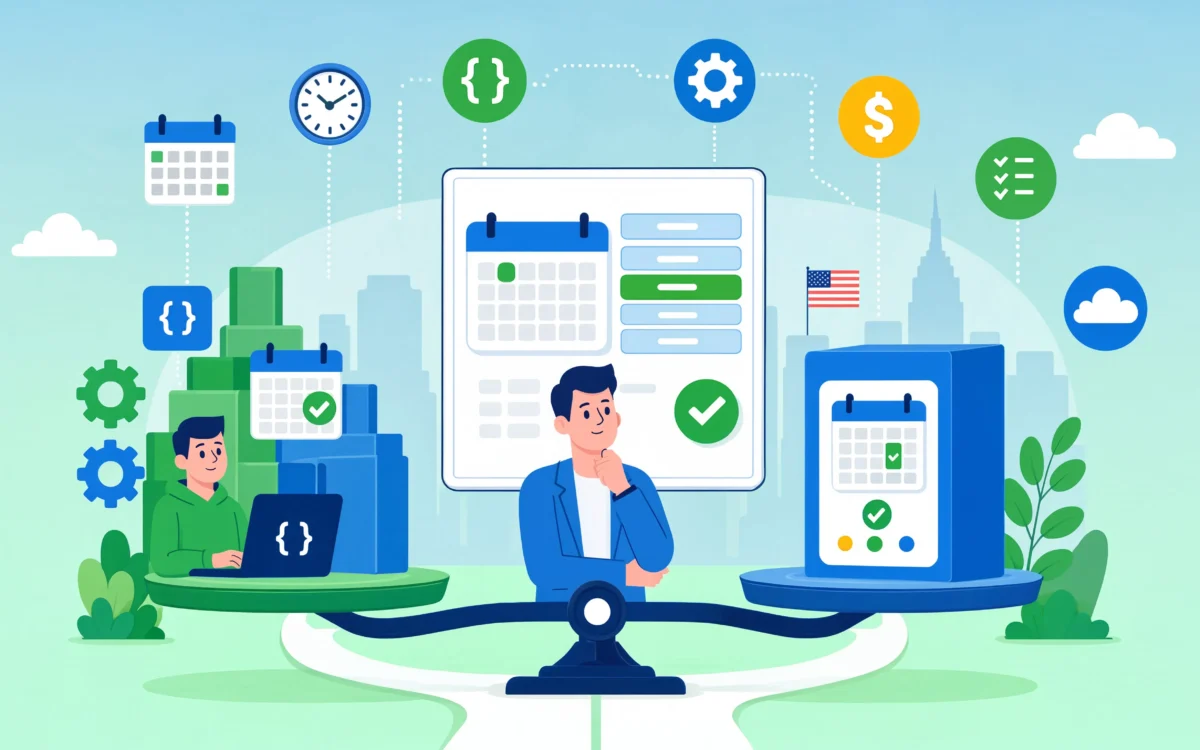
Custom vs Off-the-Shelf: The Honest Comparison
Before investing in custom development, run this comparison honestly. The right answer is not always “build.”
| Factor | Off-the-Shelf Tool | Custom Booking System |
|---|---|---|
| Setup time | Days | 10 to 36 weeks |
| Upfront cost | Low ($0 to $300/month) | $25,000 to $150,000+ |
| 3-year total cost | Escalating subscriptions | Fixed build plus maintenance |
| Feature fit | Partial | Exact |
| Integration depth | Limited by vendor APIs | Unlimited via custom APIs |
| Data ownership | Vendor servers | Your infrastructure |
| Scalability | Capped by plan limits | Unlimited |
| Brand experience | Generic or lightly branded | Fully custom |
| Compliance (HIPAA, SOC 2) | Partial (manual configuration) | Purpose built from day one |
| Roadmap control | Vendor decides | You decide |
The 3-Year Cost Calculation
The comparison only makes sense over the full life of the system. Off-the-shelf tools look cheaper on day one because the upfront cost is low. Custom development looks expensive because the number is large and visible. But over three years, the math often shifts.
Take a healthcare group using Acuity at $61 per month on the HIPAA-compliant plan. That is $2,196 over three years for a basic tool that still requires manual configuration for compliance and loses calendar sync with Outlook and iCloud when HIPAA mode is enabled. Add the cost of workarounds, the per-seat pricing as the team grows, and the features the vendor has not built yet, and the real cost climbs significantly.
A purpose-built HIPAA-compliant booking system at $60,000 to $80,000 delivers exact feature fit, full integration with your EHR, unlimited users, and a roadmap you control. At that size of business, the investment often pays for itself within 12 to 18 months.
The calculation that matters most: multiply your annual booking volume by the commission percentage a platform-based tool charges. FareHarbor takes around 6% per booking for tours and activities, landing near 7 to 9% once card processing is included. A business doing $500,000 in annual bookings is paying $35,000 to $45,000 per year in commissions alone. That is the budget they are already spending on the wrong tool.
When Custom Booking System Development Is the Right Decision
There are clear triggers. If two or more of the following apply to your business, custom development will almost always deliver better long-term value than any off-the-shelf alternative.
Compliance requirements. If you operate in healthcare (HIPAA), financial services (SOC 2), or legal services, most generic booking tools were not built with your compliance framework in mind. Calendly does not offer a Business Associate Agreement on standard plans. Acuity loses Outlook and iCloud sync when HIPAA mode is enabled. A custom build bakes compliance into the architecture from day one rather than configuring around it.
Complex workflows that no tool matches. A healthcare group with 30 providers across 6 locations needs booking logic that factors in specialty, insurance acceptance, location proximity, telehealth availability, and provider load simultaneously. Calendly handles two or three routing conditions through its form logic. A custom system handles all of them. When your real workflow requires more conditions than the tool supports, you are always running on workarounds.
Deep integration requirements. Off-the-shelf platforms connect to popular tools through preset integrations. If you need a booking system that writes directly to Epic, Cerner, Salesforce, a proprietary CRM, a field service management platform, or internal databases via custom APIs, generic tools cannot do it. Custom development builds the integration layer you actually need.
Data ownership is non-negotiable. When your client data lives on a vendor’s servers under a vendor’s terms, your business continuity depends on their continued operation. Enterprise healthcare, legal, and financial services businesses often cannot accept this arrangement. Custom development means your data lives on your infrastructure.
High booking volume with commission-based pricing. If you are paying a percentage per booking to a platform provider, the commission math eventually tips in favor of a custom build. At $500,000+ in annual booking revenue, you are likely already paying for the build through ongoing commissions.
Brand experience is a competitive differentiator. Clients booking through a third-party interface with another company’s logo are not experiencing your brand. For premium professional services, luxury hospitality, and high-value B2B services, a fully branded booking experience is part of the product.
Multiple staff, locations, or service providers. The more complex your availability and resource management, the more constrained off-the-shelf tools become. Multi-location, multi-staff systems with facility resource management, instructor assignment logic, and capacity controls quickly exceed what Mindbody, Acuity, or Calendly were designed to handle.
Custom Booking System Development Cost in the USA (2026)
Cost ranges reflect real-world US market projects in 2026. The range within each tier is driven primarily by integration complexity, compliance scope, and whether a mobile app is included.
| Tier | What Is Included | Typical Investment | Timeline |
|---|---|---|---|
| MVP Booking System | Core scheduling, payments, automated notifications, basic admin panel | $25,000 to $60,000 | 10 to 16 weeks |
| Mid-Tier Platform | Multi-staff, multi-location, CRM integration, custom intake forms, analytics dashboard | $60,000 to $150,000 | 4 to 7 months |
| Enterprise Platform | HIPAA or SOC 2 compliance, marketplace architecture, EHR/EMR integration, multi-tenant architecture | $150,000 to $300,000+ | 6 to 12 months |
What Drives Cost Up
Compliance scope. HIPAA-eligible hosting on AWS, Business Associate Agreements, encryption implementation, access controls, audit logging, and workforce training documentation add meaningful cost compared to a non-compliant build. For healthcare and fintech businesses, this is non-negotiable, not optional.
Number of integrations. Each integration, whether a CRM, EHR, payment gateway, calendar system, or internal database, adds design, development, and QA work. A booking system with one Stripe integration costs significantly less than one connecting to Epic, Salesforce, and a proprietary warehouse management system.
Mobile app scope. A companion iOS and Android app for staff or clients using React Native adds $15,000 to $40,000 depending on feature parity with the web platform.
Architecture complexity. A single-business booking system costs less than a marketplace where multiple providers each have independent availability, pricing, and services with split payments and dispute workflows.
Development team location. US-based agencies typically charge $125 to $250+ per hour for senior development work. European agencies with US market experience run $50 to $99 per hour for equivalent seniority. The same project can cost half as much through a well-vetted European partner without a corresponding drop in quality.
What Drives Cost Down
A focused MVP with one service type, one payment flow, and basic notifications built on proven architecture is the fastest path to a working system. Resist the urge to build every feature at launch. The best custom booking systems start focused and evolve based on real usage data.
Industries That Get the Most From Custom Booking System Development in the USA
Healthcare and Medical Practices
Healthcare is the largest US market for custom appointment booking software. HIPAA compliance alone eliminates most off-the-shelf tools or forces manual workarounds that introduce compliance risk. A custom build delivers HIPAA-eligible hosting, HL7 FHIR integration with EHR systems like Epic and Cerner, multi-practitioner scheduling with specialty and insurance routing, patient intake forms with secure document handling, insurance verification at the point of booking, and telehealth video integration within a single platform.
Legal and Professional Services
Law firms, accounting practices, and advisory businesses need a booking experience that reflects the seriousness of their brand and the specific requirements of their intake process. Conflict checking workflows, matter and engagement code capture, secure document upload at booking, and full calendar integration with Microsoft Exchange and Google Workspace are requirements that consumer booking tools were not designed to meet.
Fitness, Wellness, and Sports Organisations
Class bookings with capacity limits, membership-gated access, recurring series, instructor assignment logic, facility resource management, and waitlist handling, built to handle thousands of concurrent registrations without performance degradation during peak sign-up windows.
Hospitality, Hotels, and Restaurants
A custom hotel booking system gives independent properties a direct booking channel that competes with OTAs like Booking.com and Expedia without the 15 to 25% commission per reservation. For restaurants, custom development enables real-time table management, group reservation workflows, pre-payment for fixed-price menus, and full POS integration.
Construction and Field Services
Scheduling for site visits, inspections, crew assignments, and equipment deliveries across multiple active projects, with geolocation-based routing, technician skill matching, and offline mobile functionality for low-connectivity job sites.
Events and Entertainment
Ticketing, session registration, speaker scheduling, exhibitor management, and attendee communication in a single platform, scaling from a 50-person workshop to a 10,000-person conference without a platform change.
Solar and Energy Services
Site assessment bookings, installation crew scheduling, and maintenance visit management across large territories, with route optimisation and technician certification matching built into the availability logic.
Marketplace Platforms
Multiple providers with independent availability, pricing, and services, all bookable from a single platform, with simultaneous booking handling, split payments, commission tracking, and dispute workflows built into the architecture from day one.
Core Features of a Custom Booking System
What your custom booking system should include depends on your specific workflows. These are the features most US businesses need, scaled to their requirements.
Real-time availability engine. Live calendar sync across every staff member, room, or resource. Availability updates the moment a booking is made, modified, or cancelled, with no manual refresh required.
Self-service client booking portal. Mobile responsive, fully branded, accessible 24/7. The booking portal is often the first touchpoint a client has with your business, so it should reflect your brand, not a generic third-party interface.
Automated communications. Confirmation emails, appointment reminders, rescheduling notifications, and follow-up messages triggered automatically by booking events. SMS and email channels. Reduced no-shows and eliminated manual follow-up work.
Payment processing. Stripe or Braintree integration with deposit options, full payment at booking, and refund handling. For marketplace platforms, split payment logic distributes revenue automatically between platform and provider.
Multi-staff and multi-location management. A single admin dashboard with granular permission controls, staff-level calendar views, and location-based filtering. Role-based access controls keep sensitive data visible only to the right people.
Custom intake forms. Capture qualification data, medical history, project briefs, legal conflict checks, or any information your business needs at the point of booking, before the first appointment begins.
CRM synchronisation. Every booking automatically creates or updates a lead and contact record in your CRM. No manual data entry. Full audit trail of client interactions tied to booking history.
Analytics and reporting. Booking volume by staff, location, and service type. No-show rates. Revenue per booking source. Time-to-booking from first contact. Data your operations team can act on.
HIPAA and GDPR compliance. Encryption at rest and in transit, audit trails, consent management, data portability, and Business Associate Agreements where required. Built into the architecture, not bolted on.
API and webhook architecture. An open integration layer that connects your booking system to any third-party tool. If it has an API, the custom system can connect to it.
The Custom Booking System Development Process
Phase 1: Discovery and Requirements Mapping (2 to 3 weeks)
Structured workshops to document your exact workflows, user roles, integration requirements, compliance obligations, and success metrics. This phase produces a detailed technical specification and PRD before any code is written. Time spent here is always worth it. Vague requirements at this stage produce misaligned builds later.
Phase 2: UX Research and Wireframing (2 to 3 weeks)
User journey mapping for every persona using the system, from the client booking an appointment to the administrator managing availability. Interactive wireframes reviewed by your team before visual design begins. This is where workflow problems are caught cheaply, before they become expensive development rework.
Phase 3: Technical Architecture Design (1 to 2 weeks)
Database schema design, API architecture, cloud infrastructure planning, and integration mapping. Decisions made here affect scalability, security, and maintainability years after launch.
Phase 4: Agile Sprint Development (8 to 30 weeks depending on scope)
Two-week sprints with working software demonstrated at every cycle. You see real, testable functionality fortnightly, not a finished product months later. Feedback from each demo improves the next sprint.
Phase 5: Integration Development (overlaps with Phase 4)
CRM, payment gateway, calendar systems, EHR, and other third-party integrations developed in parallel with core features. Each integration has its own auth flow, sandbox environment, and edge cases that require dedicated QA.
Phase 6: QA and Security Testing (2 to 4 weeks)
Load testing for peak booking volumes. Penetration testing. HIPAA or GDPR compliance audit. Cross-device and cross-browser testing. Performance benchmarking against agreed response time targets.
Phase 7: Cloud Deployment and DevOps (1 to 2 weeks)
CI/CD pipelines for automated deployment. Monitoring and alerting configuration. Auto-scaling setup for demand spikes. Staging environment for future releases.
Phase 8: Training, Documentation, and Launch
Admin training sessions. Full technical documentation covering every integration, API endpoint, and administrative workflow. Handover of all credentials and repository access.
Phase 9: Post-Launch Support and Iteration (ongoing)
Most custom booking systems continue evolving after launch based on real usage data. Ongoing development sprints add features, optimise performance, and integrate new tools as the business grows.
Technology Stack Used in Custom Booking System Development
The right stack depends on your scale, compliance requirements, and existing infrastructure. This is what a modern US-market custom booking system is typically built on in 2026.
| Layer | Technology | Why |
|---|---|---|
| Frontend | React.js or Next.js | Server-side rendering for SEO, fast load times, component reusability |
| Mobile | React Native | Single codebase for iOS and Android, consistent experience across devices |
| Backend | Node.js or Python (Django/FastAPI) | High-performance API handling, large developer talent pool in the US |
| Database | PostgreSQL | Reliable relational database for transactional booking data |
| Real-time | Redis + WebSockets | Live availability updates without page refresh |
| Payments | Stripe | Card processing, marketplace splits, subscription billing |
| Cloud | AWS or GCP | Auto-scaling, 99.9% uptime SLA, HIPAA-eligible hosting environments |
| Notifications | Twilio (SMS) and SendGrid (email) | Reliable delivery, deliverability tracking |
| Search | Algolia or Elasticsearch | Fast provider and service discovery for marketplace platforms |
| Auth | Auth0 or custom JWT with SAML 2.0 | Enterprise SSO support, HIPAA-eligible session management |
How to Choose a Custom Booking System Development Company in the USA
Not every software agency that lists “booking systems” as a service has the experience to build one well. Evaluate any partner on these criteria before signing a contract.
Direct booking platform experience. Ask for examples of booking systems they have built, not just general web or app development. A team that has built a healthcare scheduling platform before understands the specific challenges of availability management, compliance, and provider routing in a way a general web agency does not.
Named compliance experience. If you operate in healthcare or fintech, ask specifically for a HIPAA or SOC 2 example. Ask who handles the Business Associate Agreement and how compliance is tested during QA. Vague answers are a red flag.
A milestone-based delivery process. Fortnightly demos of working software. Fixed scope proposals with clear deliverables at each milestone. No “we will show you everything at the end” arrangements. You should see real, testable functionality every two weeks throughout development.
Post-launch support terms. A booking platform needs ongoing iteration after launch. Ask how the agency handles post-launch support, what retainer arrangements look like, and whether the same development team continues or is replaced by a maintenance team.
Clear code ownership terms. All code, documentation, and assets should transfer to you on delivery and payment. Confirm this is explicit in the contract before signing anything.
Communication infrastructure. Time zone overlap matters. Responsiveness during your business hours matters. Ask what the communication cadence looks like during active development and who your point of contact is when something goes wrong.
Custom Booking System Development vs Open Source
Some US businesses consider open source booking tools like Cal.com or Easy!Appointments as a middle ground between SaaS and full custom development. Understanding the real trade-offs prevents an expensive mistake.
Open source gives you:
- Low initial licensing cost
- An active developer community
- A codebase you can modify
Open source requires you to:
- Maintain a technical team capable of customising and running the codebase
- Apply security patches consistently as vulnerabilities are discovered
- Build enterprise integrations yourself, since open source tools have limited native connectivity
- Navigate HIPAA compliance independently, which requires significant technical work on top of the base platform
Custom development gives you:
- A system engineered exactly to your requirements, not someone else’s generalised use case
- No ongoing licensing fees. You own the codebase outright
- Full integration capability through purpose-built APIs
- Compliance built into the architecture from day one
- A development roadmap you control entirely
For US businesses with compliance obligations, deep integration requirements, or brand experience standards, custom development consistently delivers more long-term value than open source alternatives, which often cost more over time once the internal engineering overhead is factored in honestly.
Frequently Asked Questions
What is custom booking system development? Custom booking system development is the process of building a reservation, appointment, or scheduling platform specifically for your business workflows, rather than using a generic off-the-shelf tool. The development team designs the database architecture, user flows, integrations, and compliance requirements from scratch to match your exact operational needs.
How much does custom booking system development cost in the USA? Custom booking system development in the USA costs $25,000 to $60,000 for an MVP, $60,000 to $150,000 for a mid-tier platform with multi-staff and CRM integration, and $150,000 to $300,000+ for enterprise platforms with HIPAA compliance, marketplace architecture, or deep EHR integration. Cost scales with integration complexity, compliance scope, and whether a mobile app is included.
How long does it take to build a custom booking system? An MVP booking system takes 10 to 16 weeks from requirements to launch. A full-featured platform with compliance requirements, multiple integrations, and a mobile app takes 5 to 9 months. Timeline accuracy depends heavily on how clearly requirements are defined during the discovery phase.
When does custom booking system development make sense over off-the-shelf tools? Custom development makes sense when your workflows require more than generic tools support, when compliance (HIPAA, SOC 2) makes off-the-shelf configurations inadequate, when integration depth with EHR, CRM, or proprietary systems is required, when you are paying significant commissions to a platform provider, or when your brand experience cannot be compromised by a third-party interface.
Can a custom booking system integrate with our existing CRM, EHR, or payment tools? Yes. Custom booking systems are built with an open API and webhook architecture that connects to any system with an accessible API. Common integrations include Salesforce, HubSpot, Epic, Cerner, Stripe, Braintree, QuickBooks, Xero, Google Workspace, Microsoft Exchange, and Twilio. If it has an API, a custom system can connect to it.
Is a custom booking system HIPAA compliant? A custom booking system can be built to HIPAA standards when the development team implements the required technical safeguards: HIPAA-eligible hosting on AWS, encryption at rest and in transit, access controls, audit logging, and a signed Business Associate Agreement before any PHI is handled. HIPAA compliance must be built into the architecture from day one, not retrofitted after launch.
What is the difference between a custom booking system and a marketplace booking platform? A custom booking system serves a single business with one or more staff or resources. A marketplace booking platform connects multiple independent providers, each with their own availability, pricing, and services, with a central platform managing the booking flow, split payments, and dispute resolution. Marketplace architecture is significantly more complex and typically falls in the $150,000 to $300,000+ investment range.
Do you provide ongoing support after the booking system launches? Yes. Most businesses continue evolving their booking platform after launch based on real usage data. Ongoing support is typically structured as monthly development sprints that add features, integrate new tools, and optimise performance as the business grows.
Ready to Build Your Custom Booking System?
Every manual workaround in your current booking process is a cost you are absorbing that custom development eliminates permanently. The question is not whether a custom system would serve your business better. It is whether the investment is justified at your current scale.
Contact Software Flux Solutions for a free discovery call. We will review your current workflows, identify exactly where a custom system delivers value, and give you a transparent cost and timeline estimate with no obligation.
Or explore our related guides:
- Booking System Development Agency for US Businesses
- How to Build a Booking System
- SaaS Development Services
- Why US Companies Outsource Software Development
- SaaS Requirements: The Complete Checklist

Zainab Bibi
Senior SAAS Project Manager
1+ Years of Experience in SAAS Projects Management