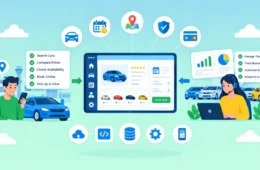
Car Rental Software Development: The Complete Guide for 2026
Car rental software development is the process of designing, building and scaling the digital platform that lets a rental business manage its fleet, take bookings, verify drivers and get paid, all without the manual spreadsheets and phone calls that still run a surprising number of rental operations today. Whether you are a traditional rental agency moving off legacy desktop software, a startup building a peer to peer marketplace in the style of Turo, or a corporate fleet operator automating internal vehicle allocation, the fundamentals of building the right platform are the same, and getting them wrong early is expensive to fix later.
This guide walks through the strategic side of car rental software development that most technical breakdowns skip: how to find product market fit before you write a line of code, how to sequence your roadmap so you are not building features nobody asked for, which technology choices actually matter, how to go to market once the product exists, and how rental platforms actually make money.
Why Car Rental Software Is a Real Market Opportunity Right Now
The car rental software market has moved decisively from on premise, desktop bound systems toward cloud based SaaS platforms, and that shift is still in progress rather than finished, which is exactly why the opportunity window is open. Analysts covering the space put the market in the low billions of dollars today with high single digit to double digit annual growth through the next decade, driven by a few concrete forces rather than vague “digital transformation” language.
Cloud adoption is the default now, not the exception. Rental operators of every size are moving away from locally installed reservation software toward platforms they can access from anywhere, update without an IT visit, and scale across new locations without new servers.
Subscription and car sharing models are growing faster than traditional rental. Monthly vehicle subscriptions and peer to peer sharing platforms are pulling meaningful volume away from the classic daily rental model, and the software underneath each of these models is different enough that a generic reservation system will not serve all three.
AI driven dynamic pricing and telematics are becoming baseline expectations. Customers increasingly expect pricing that responds to demand in real time and operators expect fleet health data that flows automatically from the vehicle rather than from a technician’s clipboard.
Electric vehicles are adding a new layer of software complexity. Charging station mapping, battery range tracking and EV specific pricing are becoming standard requirements rather than a future consideration, and platforms built without this layer in mind are already starting to show their age.
None of this means every car rental software idea is a good one. It means the underlying market is expanding and shifting shape, which rewards founders and development teams that pick a specific segment and build for it deliberately instead of building a generic booking system and hoping it fits everyone.
Finding Product Market Fit for a Car Rental Platform
The single most common mistake in car rental software development is building a feature complete reservation system before confirming which kind of rental business the product is actually for. “Car rental software” is not one market, it is several distinct ones with different buyers, different workflows and different willingness to pay.
Segment the Market Before You Build
Traditional fleet operators. Airport counters, independent local agencies and regional rental chains running a defined fleet from fixed locations. This segment values reliability, integration with existing accounting and insurance workflows, and counter operations support more than flashy consumer features.
Peer to peer and car sharing marketplaces. Platforms connecting private vehicle owners with renters, in the mold of Turo or Getaround. This segment lives or dies on trust and safety features, identity verification, insurance handling and a two sided marketplace experience rather than a single sided booking tool.
Corporate and fleet as a service platforms. Businesses managing internal vehicle pools for employees, or B2B platforms renting fleets to other companies. This segment prioritizes utilization reporting, cost allocation across departments, and integration with existing procurement and expense systems.
Subscription and long term rental platforms. Vehicle subscription services that bundle insurance, maintenance and swapping into a single monthly fee. This segment needs recurring billing logic and lifecycle management that a short term daily rental system was never designed to handle.
Validate the Workflow, Not Just the Idea
Before committing to a full build, the workflow that matters most is the one your target user already follows today, often on paper, in a spreadsheet, or inside software they are actively frustrated with. Talk to rental operators or hosts in your chosen segment and map their actual booking to return to payment to maintenance cycle in detail. The features that remove friction from that real, existing workflow are the ones worth building first. Features that sound impressive in a pitch deck but do not map to a step someone currently struggles with are the ones that quietly inflate a roadmap without moving the product closer to product market fit.
The Product Roadmap: From MVP to Full Platform
A car rental platform built in one large release, with every feature from telematics to AI pricing included from day one, almost always takes longer to ship and costs more to maintain than one built in deliberate phases. A roadmap structured around proving value early, then expanding, reduces risk at every stage.
Phase One: The Core Booking Loop
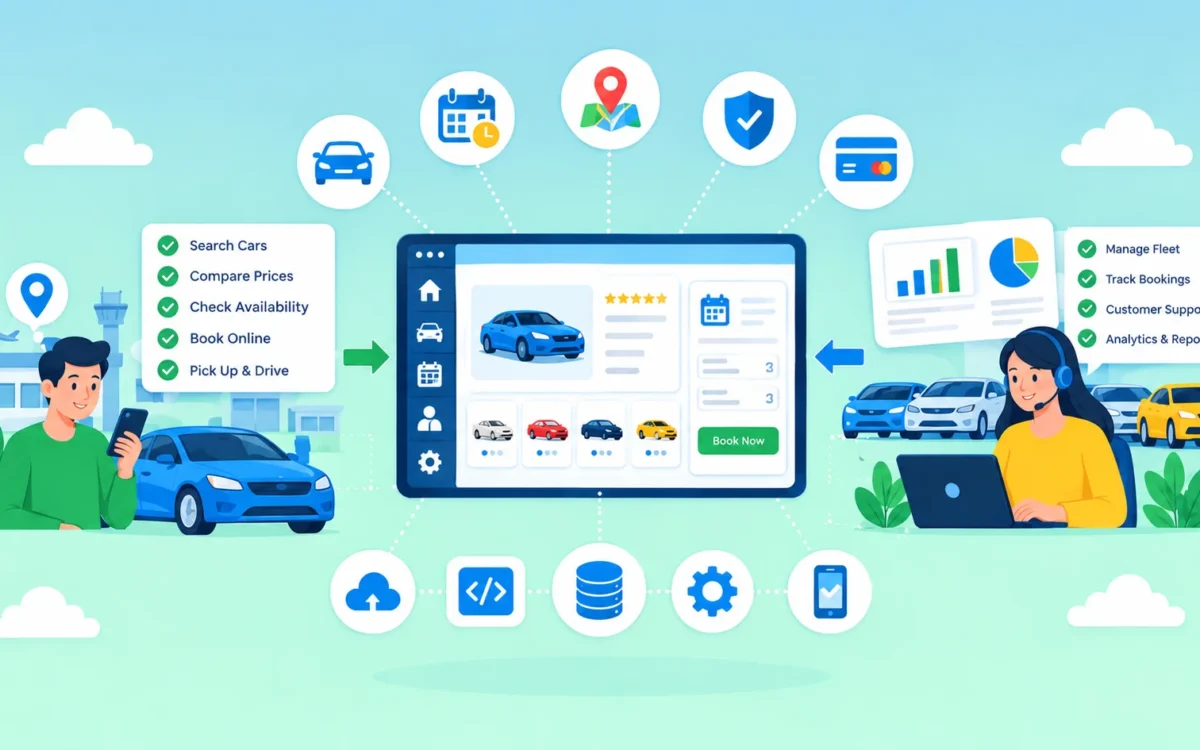
The first release should do one thing completely: let a customer find an available vehicle, book it, pay for it, and let the operator confirm, hand over and close out that booking. This includes a basic vehicle catalog, a calendar aware availability engine, a payment integration, and a simple operator dashboard to manage bookings. Nothing else matters until this loop works end to end without manual intervention.
Phase Two: Operational Depth
Once the core loop is live and in use, the second phase adds the features that reduce day to day operational overhead for the business running the platform: fleet and maintenance scheduling, driver or renter verification workflows, automated contracts and digital signatures, and reporting on utilization and revenue per vehicle. This is also the phase where mobile apps for customers and for field staff typically get built, since by now you know which workflows actually need to happen outside a desk.
Phase Three: Differentiation and Scale
The third phase is where the features that separate a competent platform from a category leading one get added: GPS and telematics integration for live vehicle tracking, AI assisted dynamic pricing, EV specific features like charging station mapping and range tracking, multi location and multi currency support for geographic expansion, and deeper integrations with insurance providers, online travel agencies and corporate travel management systems. Building these before phases one and two are solid is the most common way car rental software projects stall, because the foundation underneath them is not stable enough to support the complexity.
Core Features Every Car Rental Platform Needs
Regardless of which market segment you are building for, a credible car rental platform needs a baseline set of capabilities before anything else is worth adding.
Real time vehicle availability and booking engine. The system of record for what is available, where, and when, with no double bookings and no manual recalculation required.
Fleet and maintenance management. Tracking vehicle condition, service schedules and downtime so that unavailable vehicles are automatically removed from bookable inventory.
Digital payments and automated billing. Secure payment capture, deposits, late fee calculation and refunds handled without a staff member manually processing a card terminal.
Driver verification and identity checks. Especially critical for peer to peer and marketplace models, where trust between strangers is the product.
GPS tracking and telematics. Live location data supports both operational use cases like recovery of overdue vehicles and customer facing use cases like real time vehicle finding.
Digital contracts and e-signatures. Rental agreements generated and signed electronically at the point of booking or pickup, with a clean audit trail.
Admin and reporting dashboard. A single place for the operator to see fleet utilization, revenue, and operational exceptions without exporting data into a separate spreadsheet.
Mobile apps for customers and staff. A booking experience customers expect to be mobile first, and a field facing app for staff handling pickups, returns and vehicle inspections.
Choosing the Right Tech Stack
The technology choices behind a car rental platform matter less for any single feature and more for how well the stack holds up as you move from phase one to phase three of the roadmap above. A stack chosen only to ship the MVP quickly can become the reason phase three stalls.
| Layer | Common Choices | Why It Matters |
|---|---|---|
| Frontend | React, Next.js, Vue.js | Fast, component driven interfaces that support both web and mobile reuse |
| Mobile | React Native, native iOS and Android | Field staff and customer apps that work reliably offline and online |
| Backend | Node.js, Python (Django, FastAPI), Ruby on Rails | API driven architecture that supports multiple front ends cleanly |
| Database | PostgreSQL, MongoDB | Relational integrity for bookings and billing, flexibility for catalog data |
| Cloud Infrastructure | AWS, Google Cloud, Azure | Elastic scaling for seasonal demand spikes without over provisioning |
| Payments | Stripe, Braintree, Adyen | PCI compliant payment handling without building it from scratch |
| GPS and Telematics | Google Maps Platform, dedicated telematics APIs | Real time location and vehicle health data |
| Identity Verification | Onfido, Jumio, Stripe Identity | Automated, compliant driver and renter verification |
The architecture decision that matters most beyond individual tool choices is building on an API first foundation from day one. A platform built as a monolith with the mobile app, admin dashboard and customer booking flow all tightly coupled to one codebase becomes genuinely difficult to extend once you reach phase three integrations. A clean separation between your core booking and fleet engine and the interfaces built on top of it is what makes later additions like a corporate self-service portal or a white label version of your platform realistic rather than a rebuild. This is the kind of architectural decision that benefits from being made with an experienced SaaS development partner rather than retrofitted after launch.
Build vs Buy: Custom Platform or White Label Software
Not every rental business needs a custom built platform, and knowing when a white label or off the shelf solution is the smarter starting point is as important as knowing how to build one.
| Decision Factor | Buy (White Label / SaaS) | Build (Custom Platform) |
|---|---|---|
| Time to launch | Fast, often weeks | Slower, measured in months |
| Differentiation | Limited, shares a codebase with other operators | Full control over features and user experience |
| Workflow fit | Works well for standard rental workflows | Necessary when your workflow does not fit a generic model |
| Scalability ceiling | Constrained by the vendor’s roadmap and pricing tiers | Scales exactly as far as your own architecture allows |
| Ownership of data and IP | Shared with or owned by the vendor | Fully owned by your business |
| Best suited for | Single location operators validating demand | Multi segment platforms, marketplaces, and scaling brands |
The practical path most growing rental businesses take is not a single choice made once. It is starting with an existing platform to validate demand and operational fit, then moving to a custom build once specific limitations in the off the shelf product start costing real bookings, flexibility or margin. The signal that it is time to move from buy to build is rarely “we have grown,” it is “the off the shelf platform is now actively preventing a specific feature our customers are asking for.” Building before that signal shows up usually means building ahead of a need you have not confirmed yet.
Go to Market Strategy for a Car Rental Platform
A well built platform with no customers is not a business, and go to market planning for car rental software needs to start well before launch, not after.
Supply side first for marketplace models. If you are building a peer to peer or two sided marketplace, the vehicles have to exist on the platform before renters have a reason to visit. Early go to market effort should concentrate on recruiting enough vehicle owners or fleet partners in a single geographic area to make the renter side experience feel genuinely useful, rather than spreading thin across multiple cities from day one.
Channel partnerships for traditional fleet software. For software sold to existing rental operators rather than consumers, the fastest path to initial customers is usually partnerships with industry associations, insurance brokers who already serve rental businesses, and referrals from complementary vendors like vehicle tracking hardware providers, rather than broad consumer marketing.
Distribution integrations extend reach without extra acquisition spend. Connecting your booking engine to online travel agencies and existing booking channels multiplies the audience that can discover your inventory without requiring you to build that audience yourself from scratch.
Local SEO and search intent matter more than most founders expect. Searches like “car rental near me” and location specific rental queries carry high commercial intent, and a platform with clean, fast, well structured location pages captures demand that paid acquisition alone would cost significantly more to win. This is an area where investing in SEO and digital marketing work early pays for itself as the platform scales into new markets.
Corporate and B2B channels for fleet as a service. For platforms targeting corporate fleets, the sales motion looks more like enterprise software sales than consumer marketing, direct outreach to fleet managers and procurement teams, pilot programs with a single department before a company wide rollout, and case studies that quantify utilization improvements rather than feature lists.
Pricing Strategy: How Car Rental Platforms Actually Make Money
The monetization model you choose shapes almost every other product decision, so it deserves to be settled early rather than treated as an afterthought once the platform is built.
Commission based marketplaces take a percentage of each booking, which aligns the platform’s incentives directly with transaction volume and works well for peer to peer and two sided models where the platform is facilitating a transaction between two other parties rather than owning the fleet.
Subscription SaaS pricing charges rental operators a recurring fee for access to the software itself, typically tiered by fleet size or feature access, which suits software sold to traditional rental businesses and fleet operators as an operational tool rather than a marketplace.
Per booking or transaction fees charge a flat or variable fee per completed rental rather than a percentage, which can appeal to higher value, lower volume segments like corporate or long term rentals where a percentage commission would be disproportionate to the actual cost of facilitating the booking.
Dynamic, demand responsive pricing for the rentals themselves is a separate layer from how the platform monetizes, and refers to how the end customer is charged for the vehicle. AI assisted pricing that adjusts rates based on demand, location and booking patterns in real time is increasingly expected by renters and can meaningfully improve fleet utilization and revenue per vehicle for the operator using the platform.
Most successful platforms settle on one primary monetization model rather than stacking several at once, since mixing a commission model with a subscription fee on the same transaction tends to create pricing confusion for the exact users you are trying to build trust with.
Common Mistakes in Car Rental Software Development
Building for every segment at once. A platform trying to serve airport counters, peer to peer hosts and corporate fleets simultaneously from the same core workflow usually ends up serving none of them particularly well.
Treating telematics and AI pricing as phase one features. These are genuine differentiators, but bolting them onto an unstable core booking system rather than a solid one tends to surface integration problems that are expensive to unwind later.
Underinvesting in identity verification for marketplace models. Trust between strangers is the actual product being sold in a peer to peer rental marketplace, and a weak verification flow undermines the platform regardless of how polished the booking experience looks.
Ignoring mobile from the start. A significant share of both booking and field operations activity happens on a phone, and retrofitting mobile support onto a desktop first architecture is consistently harder than building for both from the beginning.
Choosing a monolithic architecture to save time early. It frequently saves time in phase one and costs significantly more time in phase three, when every new integration or customer facing surface has to be untangled from the rest of the codebase.
Frequently Asked Questions
What is car rental software development?
Car rental software development is the process of building the digital platform, covering booking, fleet management, payments, verification and reporting, that a rental business or marketplace uses to run its operations and serve customers online instead of through manual, paper based processes.
How long does it take to build car rental software?
A focused MVP covering the core booking loop typically takes a few months to build properly. A full platform including fleet management, mobile apps, telematics and advanced pricing features is better planned as a phased rollout over a longer period rather than a single release.
Should I build custom software or use a white label platform?
Start with an existing platform if you need to validate demand quickly and your workflow fits a standard rental model. Move toward a custom build once specific limitations in an off the shelf product are actively costing you bookings, flexibility or differentiation that your customers are asking for.
What features matter most for a peer to peer car rental marketplace?
Identity verification, trust and safety features, insurance handling and a genuinely two sided experience for both vehicle owners and renters matter more for a marketplace model than for a traditional single fleet rental platform.
Do I need telematics and GPS tracking from day one?
No. Telematics adds real operational and customer facing value, but it belongs in a later phase once the core booking, payment and fleet management workflow is stable. Adding it to an unproven foundation tends to create more integration problems than it solves.
How do car rental platforms typically make money?
Most platforms settle on one primary model: a commission on each booking for marketplaces, a recurring subscription fee for software sold to rental operators, or a per transaction fee for higher value segments like corporate rentals. Separately, many platforms also use dynamic, demand responsive pricing for the rentals themselves to improve fleet utilization.
What technology stack is best for car rental software?
There is no single correct stack, but an API first architecture matters more than any individual language or framework choice. Common combinations include React or Next.js on the frontend, Node.js or Python on the backend, PostgreSQL for relational data, and dedicated third party integrations for payments, identity verification and telematics rather than building those layers from scratch.
Conclusion
Car rental software development rewards founders and teams who treat it as a strategic product problem first and a technical build second. Choosing a specific market segment, sequencing a roadmap that proves the core booking loop before adding differentiation features, picking a tech stack built for extension rather than just launch speed, and settling on a clear monetization model early all matter more to long term success than any individual feature.
At Software Flux Solutions, we build SaaS platforms, mobile applications and custom web platforms with this kind of phased, API first architecture built in from the start, so that the platform you launch with is also the platform you can still build on two years and three product phases later. If you are evaluating how to approach car rental software development for your business, get in touch for a conversation about your specific segment, roadmap and technical requirements.

Zainab Bibi
Senior SAAS Project Manager
1+ Years of Experience in SAAS Projects Management