SaaS Product Development Strategy: A Complete Framework
Table of Contents
- Why Most SaaS Products Fail Before They Launch
- What a SaaS Product Development Strategy Actually Covers
- Finding Product Market Fit First
- Building a Roadmap Around Evidence, Not Guesses
- Choosing a Tech Stack That Will Not Box You In
- Go to Market Strategy Before the Product Is Finished
- Pricing Strategy as Part of the Product, Not an Afterthought
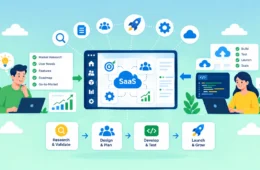
- The Development Process, Step by Step
- Starting Lean With an MVP
- What the Build Actually Costs
- Choosing the Right Development Partner
- Mistakes That Derail SaaS Product Strategy
- Conclusion
SaaS product development strategy is usually the thing founders skip, not because they do not know it matters, but because building feels more productive than planning. A founder we spoke with had spent eight months and a meaningful chunk of a seed round building a full featured platform before running a single customer conversation about pricing. The product worked. Nobody had figured out who would pay for it, how much, or why they would choose it over the three competitors already in the market. The build was not the problem. The absence of a strategy behind it was.
That story plays out constantly in SaaS, because building software has become relatively easy and building the right software, for the right customer, at the right price, priced the right way, has not gotten any easier at all. A strategy is not a slide deck you write once and file away, it is the set of decisions, product market fit, roadmap sequencing, technical architecture, go to market approach, and pricing model, that determine whether the thing you build actually survives contact with a real market.
This guide walks through a practical framework for SaaS product development strategy, covering the five decisions that matter most and how they connect to each other.
Why Most SaaS Products Fail Before They Launch
The common explanation for SaaS failure is that the product was not good enough. In practice, a large share of failed SaaS products were technically fine and strategically absent. The team built an impressive set of features for a customer they had assumed into existence rather than validated, priced the product by copying a competitor rather than understanding their own unit economics, and planned a go to market motion only after the product was already finished and the runway was already shrinking.
A real strategy forces these decisions earlier, when they are cheap to change, instead of later, when they require rebuilding. That sequencing, decide before you build rather than build and hope, is the entire point of treating product development as a strategic exercise rather than a purely technical one.
What a SaaS Product Development Strategy Actually Covers
A workable SaaS product development strategy answers five connected questions. Who has the problem, and will they actually pay to solve it, which is product market fit. What gets built first, second, and third, which is the roadmap. What technical foundation supports that roadmap without requiring a rewrite in a year, which is the tech stack. How the product actually reaches its first customers and scales beyond them, which is go to market. And how the product captures value from the customers it wins, which is pricing.
These five pieces are not sequential chapters you complete once and move past, they inform each other constantly. A pricing model shapes what the roadmap needs to prioritize. A go to market motion shapes which technical capabilities matter most early on. Getting the full picture mapped out before development starts is exactly what a structured approach to defining software requirements is meant to achieve, treating strategy as the input to development rather than something that happens in parallel with it.
Finding Product Market Fit First
Product market fit is the point where a specific customer segment clearly needs what you are building and is willing to pay for it, not a vague sense that “people like this.” Getting there requires talking to real prospective customers before writing production code, testing whether the problem is painful enough that they are already paying for a worse solution, and being honest when the evidence says the target customer or the problem framing is wrong.
The mistake most founders make is treating product market fit as a milestone to hit once, early, and then forget. In reality, it shifts as the market changes and as competitors enter, which means the roadmap decisions that follow need to keep testing the assumption, not just the first version of it.
Building a Roadmap Around Evidence, Not Guesses
A roadmap built on guesses about what customers might want looks productive and produces very little. A roadmap built on evidence, actual customer conversations, actual usage data, actual churn reasons, moves slower in the beginning and produces something people actually use.
The practical approach is to sequence the roadmap around the smallest set of features that prove the core value proposition, then expand based on what real usage reveals rather than what seemed logical in a planning meeting. This is the same discipline behind a well scoped SaaS MVP, prove the core hypothesis first, then let real behavior guide what comes next instead of a roadmap drafted entirely in advance.
Choosing a Tech Stack That Will Not Box You In
Technical architecture decisions made in the first few months of a SaaS product tend to outlive the original team’s assumptions by years, which makes them strategic decisions, not purely engineering ones. If the product is likely to serve multiple customer segments or eventually multiple paying organizations under one platform, understanding how multi-tenant SaaS architecture works before the first line of code is written avoids a disruptive migration later, when the platform already has real customers and real data depending on it.
The same logic applies to deciding what to build versus what to integrate. Payment processing, authentication, and infrastructure monitoring rarely need to be built from scratch, and a white label approach to the parts of the stack that are not core differentiators lets the team spend its limited engineering time on the features that actually set the product apart.
Go to Market Strategy Before the Product Is Finished
A go to market strategy decides how the product will actually reach its first customers, and it needs to be designed alongside the product, not after it ships. That means deciding early whether the business will grow through self serve signups, outbound sales, content and search, or partnerships, since each of those motions implies different product requirements, a self serve motion needs frictionless onboarding, while an enterprise sales motion needs security and compliance features that a self serve product can often defer.
This connects directly back to the product itself, since the same principles behind what makes a strong SaaS product usability, clarity, a fast path to value, are what make any go to market motion actually convert, regardless of which channel brings the customer in the door.
Pricing Strategy as Part of the Product, Not an Afterthought
Pricing is one of the highest leverage decisions in a SaaS strategy and one of the most commonly delayed. Founders often build the entire product before seriously addressing how it will be priced, which means the pricing model ends up reverse engineered from whatever the product happens to measure well, rather than designed around how customers actually perceive value.
Reviewing established SaaS pricing models, usage based, seat based, tiered, or a hybrid, before the roadmap is finalized lets the team build the metering and reporting the pricing model will actually need, instead of retrofitting billing logic into a product that was never designed to measure the thing it needs to charge for.
The Development Process, Step by Step
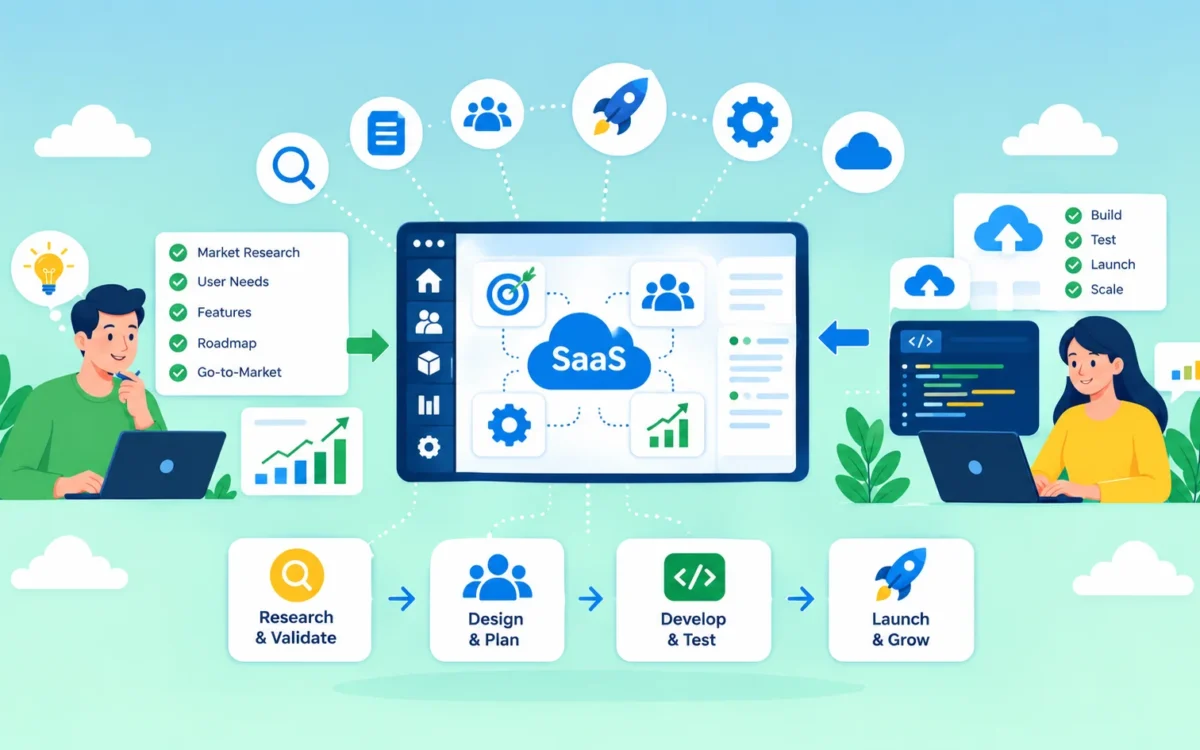
Turning a strategy into an actual product follows a fairly consistent sequence:
- Discovery and validation. Confirm product market fit through real customer conversations before committing engineering resources.
- Architecture planning. Decide the technical foundation based on where the roadmap and go to market strategy are headed, not just what is convenient today.
- Core build. Develop the smallest version of the product that proves the core value proposition.
- Go to market preparation. Build the onboarding, messaging, and channel strategy alongside the product, not after it ships.
- Launch and measure. Track real usage and revenue data against the assumptions the strategy was built on.
- Iterate based on evidence. Expand the roadmap based on what customers actually do, not what the original plan assumed.
This mirrors the broader SaaS development life cycle, with strategic validation woven through every stage rather than treated as a one time planning exercise before development begins. Many founders choose to run this process with an outside team, and a solid software development outsourcing guide is worth reading before signing any contract.
Starting Lean With an MVP
The founders who execute a SaaS strategy well rarely try to build the complete vision in version one. They identify the single hypothesis most critical to validate, usually whether the core value proposition is strong enough that customers will pay for it, and build the smallest product that tests that hypothesis honestly.
This lean approach is directly connected to the broader question of how to build a custom SaaS web application the right way, starting narrow, proving value, and expanding deliberately rather than guessing at scope before any real customer has used the product.
What the Build Actually Costs
Cost depends heavily on how disciplined the strategy phase actually was. A product built around a validated, narrowly scoped MVP costs meaningfully less than one built around an unvalidated, broad feature set that has to be reworked once real customer feedback arrives.
The factors that move the number most:
- Depth of validation work done before development starts, more upfront discovery generally reduces downstream rework
- Technical complexity introduced by the chosen architecture, particularly multi tenancy and third party integrations
- Scope of the initial roadmap, a narrowly scoped MVP costs far less than an attempt to build the full long term vision at once
- Go to market requirements built into the product, such as self serve onboarding or enterprise security features
- Ongoing iteration costs once the product is live and real usage data starts shaping the roadmap
A general breakdown of SaaS development cost factors applies here as well, with strategic clarity upfront usually being the single biggest lever for controlling cost over the life of the product. Reviewing a custom app development cost guide early also helps set realistic expectations before scoping conversations with any vendor begin.
Choosing the Right Development Partner
A development partner that only executes a predefined feature list without pushing back on strategy is a liability for an early stage SaaS product, since the strategy itself is still being tested. A partner with real product development experience will ask hard questions about product market fit, challenge an overly broad roadmap, and flag when a technical decision will make the pricing or go to market strategy harder to execute later.
The same due diligence that applies to choosing a SaaS development company matters here, and it helps to understand the broader discipline of custom application development, from scoping through delivery, before committing to any build partner, since a strategy only works if the people executing it understand why each decision was made.
Mistakes That Derail SaaS Product Strategy
A few patterns show up repeatedly in SaaS products that struggle despite solid execution:
- Building a full feature set before validating product market fit with real customers
- Treating pricing as a final step rather than a decision that shapes what the roadmap needs to measure
- Choosing a technical architecture based on what is familiar rather than where the product is actually headed
- Delaying go to market planning until the product is already built, rather than designing them together
- Ignoring real usage data in favor of the roadmap that was planned months earlier
Avoiding these comes down to treating strategy as an ongoing discipline rather than a one time document, and understanding what SaaS development actually involves before locking in a roadmap that has never been tested against a real customer.
Conclusion
SaaS product development strategy succeeds when product market fit, roadmap, tech stack, go to market, and pricing are treated as one connected decision rather than five separate workstreams. Validate the problem before building the solution, let real evidence shape the roadmap, and design pricing and go to market alongside the product rather than after it, and the resulting platform has a real chance of surviving contact with the market it was built for.
If you are shaping a SaaS strategy and want to talk through product market fit, architecture, or go to market before committing to a build, the team at Software Flux Solutions has worked across SaaS, booking, and operational platforms and can help you scope the right starting point.

Zainab Bibi
Senior SAAS Project Manager
1+ Years of Experience in SAAS Projects Management