![SaaS MVP Development Services: Complete Guide to Building Your MVP [2026]](https://softwarefluxsolution.com/wp-content/uploads/2026/09/SaaS-MVP-Development-Services-Guide-Cover-1-1200x750.webp)
SaaS MVP Development Services: The Complete Guide for Founders
Table of Contents
- What SaaS MVP Development Services Include
- SaaS MVP Development Costs
- How to Evaluate MVP Development Services
- Build vs Buy: The MVP Decision Framework
- The Tech Stack That Powers Successful SaaS MVPs
- Common MVP Mistakes to Avoid
- Frequently Asked Questions
- Conclusion
Every successful SaaS product started as an MVP. Slack began as an internal communication tool for a gaming company. Dropbox launched with a simple file-syncing feature. Airbnb started as a website with photos of a single apartment. The pattern is consistent: build the minimum version that solves the core problem, validate with real users, then scale what works.
SaaS MVP development services exist to help founders navigate this critical first build efficiently. The right MVP development partner turns your concept into a working product that attracts early users and generates the data you need to make informed decisions about what to build next. The wrong partner burns through your budget building features nobody needs.
This guide covers what SaaS MVP development services actually deliver, what they cost, how to evaluate providers, and the technical decisions that determine whether your MVP becomes a scalable product or an expensive prototype.
What SaaS MVP Development Services Include
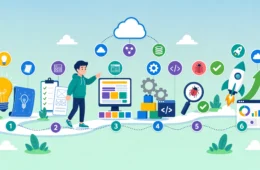
A professional SaaS MVP development engagement typically covers five workstreams delivered over 8 to 16 weeks.
Product Discovery and Requirements Definition, translating your business concept into a technical specification with clearly prioritised features. Our SaaS requirements guide details this process.
Architecture and Tech Stack Selection, choosing the technologies, infrastructure, and patterns that support both your MVP and your future scale requirements.
UI/UX Design, designing the user experience and visual interface. For SaaS, this means designing for multiple user roles, dashboard layouts, and onboarding flows.
Core Development, building the application: authentication, billing integration, core feature set, admin panel, and basic analytics.
Launch Support, deployment, monitoring setup, and post-launch bug fixes during the critical first weeks after release.
SaaS MVP Development Costs
| MVP Complexity | Scope Level | Timeline | Typical Features |
|---|---|---|---|
| Simple (1-2 core features) | Focused | 6-10 weeks | Auth, billing, one core feature, basic dashboard |
| Standard (multi-role) | Moderate | 10-16 weeks | Multiple user roles, integrations, advanced dashboard |
| Complex (AI/compliance) | Extensive | 4-8 months | AI features, regulatory compliance, marketplace logic |
| Enterprise | Full-scale | 6-12 months | Complex workflows, enterprise security, multi-region |
These ranges reflect professional development services, not freelancer marketplaces where quality is unpredictable. The investment should be evaluated against what it costs to build the wrong product: months of development on features nobody uses, a codebase that cannot scale, or a launch that fails because the product was not validated before full investment.
At Software Flux Solutions, our MVP development starts at the lower end of these ranges because we leverage proven SaaS architectural patterns across every build.
How to Evaluate MVP Development Services
Ask to see SaaS products they have built, not just websites. SaaS requires specific expertise in multi-tenant architecture, subscription billing, and user management that general web development does not provide.
Request sprint-based delivery with fortnightly demos. If a provider cannot show you working software every two weeks, they cannot deliver a quality MVP in a predictable timeline.
Verify they understand your post-MVP path. The best MVP development services plan for what comes after launch, ongoing feature development, scaling infrastructure, and iterative improvement based on user data.
Check their technical depth in your sector. Our experience spans healthcare CRM systems, booking platforms, marketplace development, and custom business applications.
Build vs Buy: The MVP Decision Framework
| Scenario | Best Approach | Why |
|---|---|---|
| Testing if the problem exists | No-code prototype | Cheapest validation before investment |
| Validated problem, building first product | Custom MVP | Scalable foundation from day one |
| Entering competitive market quickly | Custom MVP with proven stack | Speed plus quality |
| Highly regulated industry | Custom MVP with compliance | Generic tools cannot meet requirements |
| Internal tool for your team | Low-code or off-the-shelf | ROI does not justify custom build |
For founders ready to move past a prototype, a custom SaaS build gives you a foundation that can actually scale, rather than one bound by a no-code platform’s limits.
The Tech Stack That Powers Successful SaaS MVPs
Frontend: React with Next.js dominates the SaaS MVP landscape in 2026. Server-side rendering for SEO, excellent developer ecosystem, and strong performance.
Backend: Node.js for real-time applications, Python/Django for data-intensive products.
Database: PostgreSQL is the default choice for SaaS, strong multi-tenant support, ACID compliance, and excellent tooling.
Payments: Stripe is the standard for SaaS billing, subscription management, usage-based billing, and global payment support.
Infrastructure: AWS for scale, Vercel for deployment simplicity, or Azure for Microsoft ecosystem integration.
Common MVP Mistakes to Avoid
Building too many features before validation. Your MVP needs one core feature that solves one core problem. Everything else is a distraction from validation. Choosing the wrong development partner. A provider whose portfolio is brochure websites cannot build a multi-tenant SaaS application. Ignoring post-launch development. An MVP launch is the beginning, not the end. Budget for at least three months of post-launch iteration. Skipping billing integration. If you cannot charge users from day one, you cannot validate willingness to pay, and willingness to pay is the only validation that matters for a SaaS business. Over-engineering for scale. Your MVP does not need to handle 100,000 users. It needs to handle 100 users well and be architecturally capable of scaling when the time comes.
Frequently Asked Questions
How much do SaaS MVP development services cost?
Costs depend entirely on complexity, number of features, and the integrations required. Contact Software Flux Solutions for a detailed quote tailored to your MVP scope and business requirements.
How long does it take to build a SaaS MVP?
6 to 10 weeks for a simple MVP with one to two core features. 10 to 16 weeks for a standard MVP with multiple roles and integrations. 4 to 8 months for complex MVPs.
What is the difference between MVP development and full product development?
MVP development builds the minimum viable version to validate with real users. Full product development builds the complete feature set. MVP comes first; full development follows validation.
Should I hire freelancers or an agency for my SaaS MVP?
An agency with SaaS experience provides architectural consistency, project management, and a team that covers all technical disciplines. Freelancers can work for simple projects but introduce coordination risk for SaaS MVPs.
What features must my SaaS MVP include?
User authentication, subscription billing (Stripe), your single core value feature, a basic dashboard, and an onboarding flow. Nothing else at the MVP stage.
Can I build a SaaS MVP without coding?
Yes, using no-code platforms like Bubble. This is suitable for initial concept validation but creates scaling limitations. Custom development is recommended once the concept is validated.
Conclusion
SaaS MVP development services are the most efficient path from concept to validated product. The key is choosing a partner with genuine SaaS experience, maintaining disciplined scope, and planning for what comes after launch.
At Software Flux Solutions, we deliver SaaS MVP development with the architectural quality that scales beyond validation into a production business. From sports management platforms to event management systems, our full-cycle SaaS development practice builds MVPs that become market-leading products. Contact us to discuss your MVP.

Zainab Bibi
Senior SAAS Project Manager
1+ Years of Experience in SAAS Projects Management