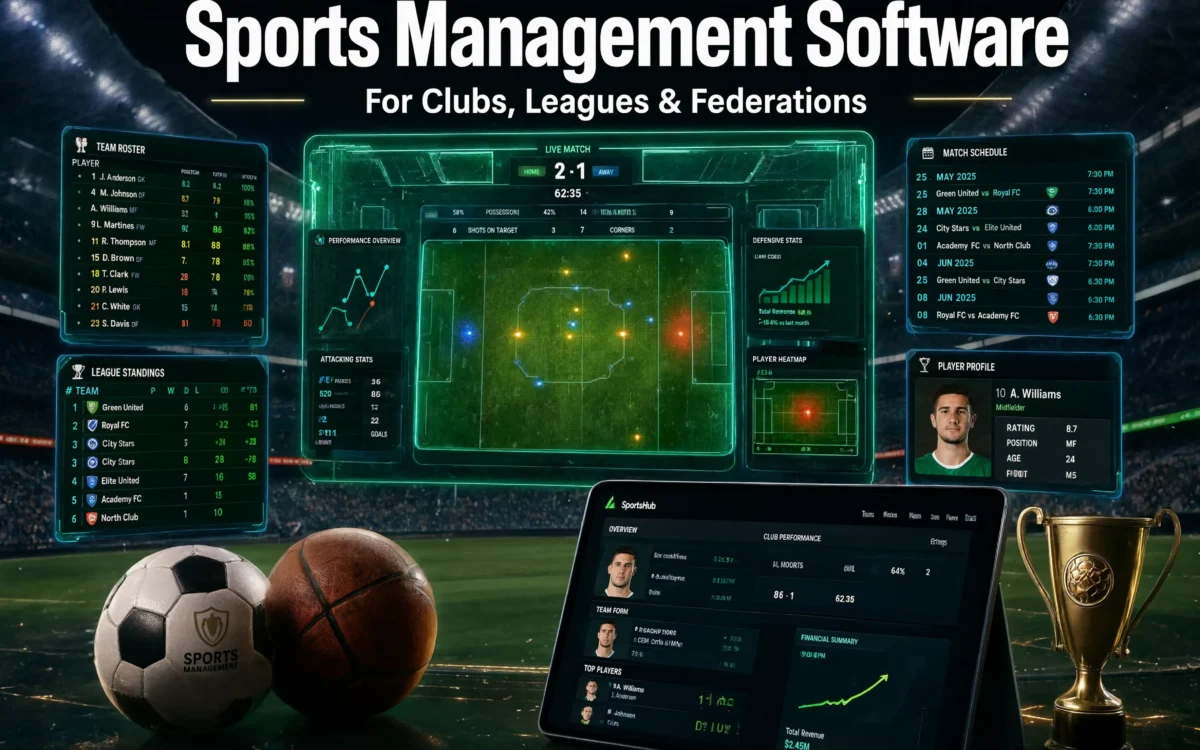
Sports Management Software Development: Build Smarter Systems for Clubs, Leagues & Federations
Sports Management Software Development: Build Smarter Systems for Clubs, Leagues & Federations
From grassroots clubs to professional leagues, sports organisations are turning to custom software to streamline operations, grow revenue, and deliver better experiences for athletes, coaches, and fans.
Table of Contents
- What Is Sports Management Software?
- Who Needs Sports Management Software?
- Core Features of a Custom Sports Management Platform
- Fixturing: Automated Fixture and Scheduling Management
- Athlete Management Software: Health, Performance and Development Records
- Sports Federation and Governing Body Software
- Sports Content Management System
- Technology Stack for Sports Management Software Development
- The Development Process: From Idea to Live Platform
- Sports Management Software Development Cost
- Football Management Software Development
- How This Fits into the Broader SaaS Development Landscape
- Why Choose Software Flux Solutions for Sports Software Development?
- Frequently Asked Questions
- Start Building Your Sports Management Platform
What Is Sports Management Software?
Sports management software is a digital platform that centralises the operational, administrative, and commercial activities of sports organisations. It replaces spreadsheets, paper forms, and disconnected apps with a single, cloud-based system accessible by staff, coaches, athletes, and parents from any device.
Custom sports management software development goes one step further, rather than adapting your workflows to a generic tool, the platform is built around how your specific organisation operates. That distinction matters more in sports than in most other sectors, since a youth football club, a national swimming federation, and a multi-sport leisure complex all run on genuinely different rules, seasons, and compliance requirements, even though off-the-shelf platforms often treat them as the same problem. The same logic that applies to custom application development generally, build around the actual workflow, not a generic template, applies with particular force here.
Who Needs Sports Management Software?
- Amateur and professional sports clubs (football, cricket, basketball, tennis, and more)
- National and regional sports federations and governing bodies
- Youth academies and school sports programmes
- Multi-sport complexes and leisure centres
- Sports event organisers and tournament directors
- Coaching academies and personal training studios
Core Features of a Custom Sports Management Platform
Member & Athlete Management
Maintain complete digital profiles for every member, registration details, medical information, performance history, attendance records, and emergency contacts, all in one secure, searchable database.
Team & Squad Management
Create teams, assign coaches, manage rosters, set availability, and track squad selections. Coaches can access squad lists, share training plans, and communicate directly through the platform.
Scheduling & Fixture Management
Automate fixture generation, venue booking, referee assignments, and calendar sync. Push notifications keep everyone informed about changes in real time.
Financial Management & Membership Fees
Collect membership fees, process event registrations, and manage sponsorship invoices through a built-in payment gateway. Generate financial reports at the click of a button. For organisations running tiered membership levels, youth, adult, family, or seasonal passes, dedicated sports payment management software features matter as much as the collection itself: recurring billing cycles, instalment plans for larger fees, automated reminders before a payment lapses, and support for multiple payment methods so no family is excluded because of how they prefer to pay. Reviewing common SaaS pricing models is a useful starting point when deciding how membership tiers and billing cycles should actually be structured in the platform.
Performance Tracking & Analytics
Record match statistics, training performance, physical metrics, and progression data. Visual dashboards help coaches and selectors make data-driven decisions.
Communication & Notifications
Send targeted messages to specific groups, all parents, senior squad, or committee members. Reduce admin overhead with automated reminders for renewals, training sessions, and match days.
Fixturing: Automated Fixture and Scheduling Management
Fixturing, the process of generating and maintaining a competition’s match schedule, is one of the most time-consuming manual tasks for any league or club administrator, and one of the features custom sports platforms are most often built to solve.
A well-built fixturing engine handles:
- Format generation. Automatically generate round-robin, knockout, group-stage, and hybrid competition structures based on the number of teams and format rules.
- Venue and resource clash avoidance. Prevent double-booking of pitches, courts, or venues across overlapping age groups and divisions.
- Referee and official assignment. Assign match officials automatically based on availability, qualification level, and travel distance.
- Dynamic rescheduling. Handle postponements from weather or venue issues by automatically proposing new slots that avoid fresh conflicts, rather than leaving administrators to manually rebuild the schedule.
- Live publishing. Push fixture changes instantly to team apps, club websites, and calendar integrations so players, coaches, and parents are never working from an outdated schedule.
For federations and multi-league operators, fixturing complexity multiplies fast, dozens of divisions, shared venues, and regulatory constraints on minimum rest days between matches all need to be modelled correctly. This is precisely the kind of logic that off-the-shelf tools struggle with and custom-built fixturing engines are designed to solve. The underlying scheduling logic, matching availability, avoiding double-bookings, confirming slots automatically, draws on the same principles behind building a booking system, applied to matches and venues instead of appointments.
Athlete Management Software: Health, Performance and Development Records
Member and athlete management, covered above, handles the basics: who someone is, how to reach them, and which team they’re on. Athlete management software goes a layer deeper, it’s the system responsible for an athlete’s health, development, and long-term progress, and it’s usually the feature set that separates a general club administration tool from something a performance-focused organisation can actually rely on.
A proper athlete management module typically covers:
- Injury and medical history tracking, including return-to-play protocols that prevent an athlete from being cleared for training or competition before the required recovery milestones are documented.
- Longitudinal performance benchmarking, tracking physical and skill metrics over seasons rather than single snapshots, so coaches can see development trends, not just a single test result.
- Individual development plans, linking training goals, coach notes, and progress reviews to each athlete’s profile rather than scattering them across separate documents.
- Consent and guardian access controls, particularly important for youth athletes, where medical consent forms, data retention rules, and parental visibility all need to be built into the permissions model rather than handled informally.
This is one of the areas where the quality of the underlying data model matters more than the interface on top of it, which is part of what separates genuinely well built platforms from ones that simply look complete in a demo.
Sports Federation and Governing Body Software
Federations and governing bodies have a fundamentally different problem from a single club: instead of managing one organisation’s members and schedule, they’re overseeing dozens or hundreds of affiliated clubs, each with its own staff, membership base, and local operations, while still needing centralised visibility and control.
Purpose-built sports federation software typically needs to handle:
- Affiliated club and member oversight, giving federation administrators real-time visibility into every member club’s registrations, compliance status, and activity, without requiring clubs to manually submit reports.
- Licensing, certification, and accreditation tracking, for coaches, officials, and referees, including renewal deadlines and qualification levels, so the federation can prove compliance during an audit without chasing paperwork.
- Regulatory and compliance reporting, structured to match whatever national or international standards the sport’s governing structure requires.
- Procurement and equipment distribution, since many federations also coordinate kit, equipment, or facility resources across member organisations, procurement software for sports organisations is often needed as part of the same system rather than as a disconnected tool.
- Centralised communication, reaching every affiliated club, or a specific region or division, without relying on scattered email threads between the federation office and dozens of volunteer club administrators.
Because every affiliated club still needs its own day-to-day experience, many federations choose a white label approach: one underlying platform, built once, given a distinct branded portal for each member club, so local administrators get software that feels like their own while the federation retains full oversight and a single, multi-tenant architecture to maintain behind the scenes.
Sports Content Management System
Administrative and operational features handle how an organisation runs, a sports content management system handles how it communicates, to members, to fans, and to the public. For clubs and federations with any kind of public-facing presence, this is a distinct feature set, not an afterthought bolted onto the admin portal.
A sports content management system typically includes:
- News and match reports, published directly from the platform without needing a separate website tool
- Media galleries and video highlights, organised by team, competition, or season
- Sponsor and partner content placements, managed centrally so sponsorship commitments are fulfilled consistently across every page and property
- Fan-facing website and app integration, so content published once appears everywhere it needs to, the club website, the mobile app, and any federation-level hub
For organisations publishing content frequently, match reports every weekend, academy updates, sponsor features, a headless CMS architecture is usually the right foundation, since it lets non-technical staff publish and update content without waiting on a developer every time something needs to go live.
Technology Stack for Sports Management Software Development
- Frontend: React.js or Angular for admin portals; React Native for mobile apps
- Backend: Node.js or Python with RESTful APIs and real-time WebSocket support
- Database: PostgreSQL for structured member data and statistical records
- Payment Integration: Stripe, PayPal, or direct bank transfer modules
- Cloud Hosting: AWS or Google Cloud for global scalability and 99.9% uptime
- Push Notifications: Firebase Cloud Messaging for iOS and Android alerts
- Calendar Integration: Google Calendar and Outlook sync for scheduling
Most organisations also want a companion app for coaches, athletes, and parents rather than a web-only experience, our work in mobile app development covers exactly this layer, built on the same React Native foundation referenced above.
The Development Process: From Idea to Live Platform
- Discovery Workshop, Mapping your current workflows, pain points, and desired outcomes
- User Research, Interviewing admins, coaches, and members to understand real usage patterns
- UI/UX Prototyping, Creating interactive mockups for stakeholder review before development begins
- Phased Development, Delivering working features in two-week sprints
- Integration Testing, Connecting payment gateways, email providers, and third-party APIs
- Pilot Launch, Rolling out to a subset of users to gather real-world feedback
- Full Deployment, Migrating all members, historical data, and going fully live
- Ongoing Development, Adding features each season based on actual usage
Sports Management Software Development Cost
Investment depends on the size of your organisation and the feature depth required:
- Club Management MVP: $20,000 – $50,000
- Federation or Multi-Club Platform: $50,000 – $120,000
- Full Ecosystem with Mobile App and Analytics: $120,000+
These ranges track closely with the broader factors covered in our general guide to SaaS development cost, user roles, integration depth, and compliance requirements move the number the most in sports platforms specifically, since federation-level builds carry more of all three than a single club does.
Software Flux Solutions provides a fixed-scope, fixed-price proposal after the initial discovery phase. Visit our Contact Us page to start the conversation.
Football Management Software Development
Football clubs, academies, and federations carry operational demands that go beyond generic sports administration, and a platform built for football specifically needs to account for them from the architecture stage, not bolt them on afterward.
A custom football management platform typically needs to handle:
- Player registration and transfer tracking, including movement between clubs, loan periods, and international clearance where relevant
- Disciplinary records, tracking yellow and red cards, suspensions, and accumulated points across a season in line with league rules
- League and federation compliance, structuring data and reporting to match the requirements set by the relevant national or regional football association
- Youth academy pathways, tracking player development from junior age groups through to senior squad progression
- Match official and referee assignment, integrated with the fixturing engine described above so official availability and qualification level are matched automatically
Because football operates under sport-specific regulatory and competition structures, a generalist off-the-shelf tool often forces clubs and federations to work around the software rather than the reverse. A custom-built platform, scoped around your specific league or federation’s rules from day one, avoids that trade-off entirely.
How This Fits into the Broader SaaS Development Landscape
Sports management is one of several specialist verticals where custom SaaS development delivers outstanding ROI. At Software Flux Solutions, we apply the same proven architectural principles across SaaS Development for Construction Companies where project and compliance management are paramount, Healthcare CRM Development for patient relationship workflows, Marketplace Development Company platforms for multi-vendor commerce, Solar Management Software Development for clean energy operations, and Event Management Platform Development for large-scale events. Each domain has its own complexity, what unites them is a need for purpose-built, cloud-native software that scales.
Why Choose Software Flux Solutions for Sports Software Development?
- Proven experience building member management systems and club portals
- Mobile-first design for coaches and athletes on the go
- Secure data handling compliant with GDPR and regional privacy regulations
- Scalable multi-tenant architecture supporting multiple clubs under one system
- Full-cycle delivery: design, development, testing, deployment, and support
Sports organisations with UK operations or UK-based member communities benefit from considering that the best web developers in london includes teams with specific, direct experience serving Premier League clubs, national governing bodies, and major sports venues concentrated in and around the capital. London’s position as host to elite professional sports organisations across football, rugby, cricket, and athletics has created a demanding tech-forward sports sector that consistently requires development quality significantly above what a general-purpose agency delivers. For sports technology platforms targeting the UK market specifically, this sports-sector development experience in London represents a directly relevant competitive advantage worth assessing during partner selection, alongside the general due diligence covered in our software development outsourcing guide for any organisation evaluating a build partner from outside its own country.
Frequently Asked Questions
Can the platform support multiple sports under one federation account?
Yes. We build multi-sport architecture where each discipline has its own data model, reporting formats, and user roles, all managed from a single administrator dashboard.
Is there a mobile app for coaches and players?
We can develop a companion iOS and Android app alongside the web platform, ensuring coaches and athletes have full access from any device.
Can members register and pay online through the platform?
Absolutely. Self-service member registration with integrated payment collection is a core feature of our sports management builds.
Can the fixturing engine handle multiple divisions and shared venues?
Yes. The fixturing engine is built to model shared venue constraints, minimum rest days between matches, and cross-division scheduling rules, which matters most for federations and multi-club operators managing many competitions at once.
Do you build football-specific features like transfer tracking and disciplinary records?
Yes. Player transfer tracking, disciplinary record management, and league or federation-specific compliance reporting are all features we scope into football management platforms based on your league’s exact rules.
What software do sports federations use?
Most federations run on some combination of member and license management, competition and fixture scheduling, compliance and certification tracking, and financial reporting, either stitched together from several disconnected tools or, increasingly, as a single custom-built platform scoped around the federation’s specific hierarchy of affiliated clubs, athletes, and officials.
Is sports management software different from fitness software?
Yes, and the distinction matters for organisations managing both. Fitness software is generally built around individual training, class bookings, and membership access for a gym or studio. Sports management software is built around teams, competitions, and organisational structure, squads, fixtures, divisions, and compliance across many members at once. A multi-sport organisation handling both player development and facility operations usually needs either a platform purpose-built to cover both, or two integrated systems, rather than trying to stretch a single-purpose fitness tool to cover team and competition management it was never designed for.
Does sports management software include procurement for team equipment and kit?
It can. For federations and multi-club organisations in particular, procurement software for sports organisations, tracking kit orders, equipment distribution, and supplier management across member clubs, is often built as part of the same platform rather than as a separate system, since it draws on the same organisational hierarchy and reporting the rest of the federation software already maintains.
Start Building Your Sports Management Platform
Whether you manage a local football club or a national federation with thousands of members, Software Flux Solutions can build the exact platform you need. Explore our full range of capabilities on our SaaS Development page, or contact us today for a free discovery call.

Zainab Bibi
Senior SAAS Project Manager
1+ Years of Experience in SAAS Projects Management