HR and Recruitment Software Development for Growing Companies
Table of Contents
- The Moment Spreadsheets Stop Being Enough
- What HR and Recruitment Software Needs to Solve
- Core Modules to Build First
- Architecture Decisions for a Growing Company
- Integrations That Determine Whether People Actually Use It
- The Development Process
- Why an MVP Approach Works Better Than a Full Rebuild
- Pricing If You Plan to Offer It Beyond Your Own Team
- Build Custom, Outsource, or White Label
- What the Build Actually Costs
- Choosing the Right Development Partner
- Mistakes That Slow HR Software Projects Down
- Conclusion
A fast-growing company usually notices the need for custom HR and recruitment software development when someone in HR is manually copying candidate information from an inbox into a spreadsheet, then copying that same information into a second spreadsheet once the person is hired, then copying it again into a payroll system that does not talk to either one.
That story plays out at almost every company somewhere between twenty and two hundred employees. The free or cheap tools that worked fine for the first ten hires start creaking under the weight of real recruiting pipelines, onboarding checklists, performance reviews, and compliance requirements that vary by role, location, and sometimes by country. At that point, a company has two options: keep adding disconnected tools, or invest in HR and recruitment software development to build a solution that actually reflects how the business hires, onboards, and manages its people.
This guide covers what it takes to build custom HR and recruitment software, from the first planning conversation through to a platform your team will actually want to use.
The Moment Spreadsheets Stop Being Enough
Every HR process starts simple. A shared spreadsheet tracks candidates, a folder holds resumes, and offer letters go out from a template in someone’s email drafts. This works fine at ten employees. It starts to break at thirty, when the same spreadsheet is being edited by three people at once and nobody is quite sure which version is current.
Packaged HR software solves part of this, but most tools are built to serve a broad market, which means they handle the generic case well and struggle with anything specific to your company: a multi stage interview process unique to your engineering team, a compliance requirement specific to your industry, or a workflow that spans recruiting, onboarding, and IT provisioning in a way no off the shelf tool anticipated.
What HR and Recruitment Software Needs to Solve
Good HR software has to serve several audiences at once, and each one wants something different from the same underlying data. Recruiters need a clear pipeline view and fast candidate communication. Hiring managers need visibility into where their open roles stand without pinging recruiting every day. New hires need an onboarding experience that feels organized, not like a scavenger hunt across five different tools. HR leadership needs reporting that actually reflects headcount, time to hire, and retention trends.
Building something that serves all of these audiences well starts with mapping the real workflow before writing any code. A structured approach to defining software requirements prevents a platform that looks great from a recruiter’s chair but frustrates hiring managers and new hires who interact with it far less often but just as meaningfully.
Core Modules to Build First
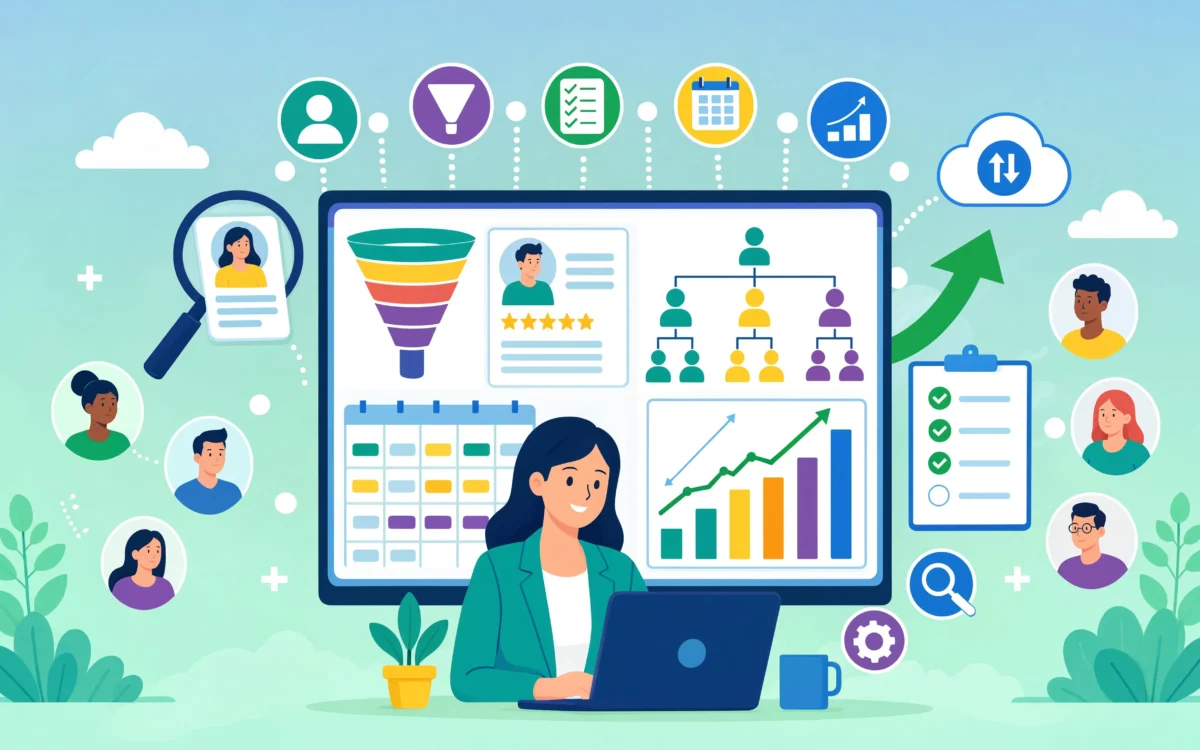
Most custom HR and recruitment platforms end up including some combination of the following:
- Applicant tracking, from job posting through interview scheduling and offer management
- Onboarding workflows that coordinate HR, IT, and the hiring manager around a new employee’s first weeks
- Employee records and document storage, with proper access controls for sensitive information
- Time off tracking and approval workflows
- Performance review cycles, whether continuous feedback or scheduled reviews
- Reporting on hiring funnel metrics, headcount, and turnover
Trying to launch all of this simultaneously rarely works. The companies that succeed tend to start with recruiting and onboarding, since those touch the business constantly during a growth phase, then expand into performance and reporting once the foundation is solid. Keeping the user experience sharp across every module matters too, and the same principles behind what makes a strong SaaS product apply just as much to internal tools as they do to customer facing software.
Architecture Decisions for a Growing Company
A company that expects to keep growing, add new departments, expand into new locations, or eventually support multiple business units, benefits from thinking about multi tenant architecture early, even if the platform only serves one company today. Understanding how multi-tenant SaaS architecture works up front means the system can later support separate business units or acquired companies without a disruptive rebuild.
Data sensitivity is the other major architecture consideration. HR systems hold some of the most sensitive data a company manages, salary history, performance reviews, medical accommodation requests, so role based access control and audit logging need to be built into the foundation, not added as an afterthought once the system is already in use.
Integrations That Determine Whether People Actually Use It
An HR platform that lives disconnected from the rest of the business rarely gets fully adopted. The integrations that matter most are usually payroll systems, so employee data does not need to be re-entered twice, calendar tools for interview scheduling, and communication platforms like email or Slack, since recruiters and hiring managers live in those tools daily and will not adopt a system that forces them somewhere new for every update.
Interview scheduling in particular deserves real thought, since coordinating multiple interviewers, candidates, and time zones is fundamentally a scheduling problem. The same logic behind appointment scheduling software in other industries, buffering, conflict detection, automated reminders, applies directly to interview coordination, even though the context is completely different.
The Development Process
Building HR software follows a familiar sequence, with extra attention paid to permissions and data sensitivity throughout, since almost every module touches information that should not be visible to everyone in the company.
- Discovery. Map the current hiring, onboarding, and HR workflow, including every handoff between recruiting, IT, and management.
- Data modeling and permissions design. Decide early who can see what, since retrofitting access control later is far more disruptive than any other part of the rebuild.
- Core build. Develop applicant tracking and onboarding first, since these have the most daily touchpoints during a growth phase.
- Integrations. Connect payroll, calendar, and communication tools once the core workflow is stable.
- Testing with real hiring data. Run the system alongside a live hiring process before fully switching over.
- Rollout and training. Recruiters, hiring managers, and new hires all need a short onboarding to the tool itself, ironically, since a confusing HR tool undermines the very onboarding experience it is meant to support.
This mirrors the standard SaaS development life cycle, with permissions and data governance woven through nearly every stage rather than treated as a final security review. Many growing companies choose to run this process with an outside team, and a solid software development outsourcing guide is worth reading before committing to any partner.
Why an MVP Approach Works Better Than a Full Rebuild
Companies that try to replace their entire HR stack in one project usually end up with a longer timeline, a bigger budget, and a system that still needs significant rework once real usage exposes gaps nobody anticipated. A better approach is to identify the single workflow causing the most pain, usually the recruiting pipeline or onboarding, and build a focused solution for that first.
This is the same discipline behind any well run SaaS MVP: prove the core value with real recruiters and real candidates before expanding into performance management, detailed reporting, or additional modules. It also means the HR team is working with a live system within weeks rather than months, which surfaces real gaps far earlier than a long, single phase build would.
Pricing If You Plan to Offer It Beyond Your Own Team
Most companies build HR software purely for internal use, but some, particularly staffing agencies or companies with a genuinely novel hiring process, eventually consider offering the platform to other businesses as a product in its own right.
If that is even a possibility down the line, it is worth thinking about pricing structure early, since adding multi tenant billing to a system that was never designed for external customers is a substantial rework later. Reviewing common SaaS pricing models provides a useful framework even for a team that plans to stay internal only for the foreseeable future.
Build Custom, Outsource, or White Label
Not every company needs to build every module from scratch. Background check integrations, e-signature for offer letters, and payroll processing are typically better licensed from established providers than built in house, which shortens the timeline considerably and avoids reinventing infrastructure that already works well.
The right balance usually comes down to how standard the company’s hiring and HR processes actually are. A company with a fairly typical hiring funnel might do well building around a white label foundation for the pieces that are not core differentiators, while a company with a genuinely unusual hiring model, high volume seasonal hiring, a complex multi stage technical assessment process, usually benefits from a build that is custom from the data model outward. Either way, reviewing a custom app development cost guide early helps set realistic expectations before scoping conversations with any vendor begin.
What the Build Actually Costs
Cost depends heavily on scope. A platform focused purely on applicant tracking and basic onboarding costs meaningfully less than a full suite covering recruiting, onboarding, performance management, and detailed workforce reporting.
The factors that move the number most:
- Number of user roles the system needs to serve, recruiters, hiring managers, new hires, and HR leadership each add complexity
- Depth of permissions and access control required for sensitive employee data
- Number of integrations, particularly payroll and calendar systems
- Whether the platform needs to support multiple locations or entities under one company
- Ongoing compliance needs, since employment regulations vary significantly by location
A general breakdown of SaaS development cost factors applies here as well, with permissions architecture usually requiring more upfront design time than in most other software categories.
Choosing the Right Development Partner
HR software touches some of the most sensitive data a company manages, which makes the choice of development partner more consequential than it might first appear. A team without experience handling sensitive personal data may not think carefully enough about access control, audit logging, or how salary information should be compartmentalized from general employee records.
The same due diligence that applies to choosing a SaaS development company matters here, and it helps to understand the broader discipline of custom application development before committing to a partner, so you know what a well run engagement actually looks like from scoping through delivery.
Mistakes That Slow HR Software Projects Down
A few patterns show up repeatedly in HR software projects that stall or underdeliver:
- Trying to replace every HR tool at once instead of starting with the workflow causing the most daily pain
- Treating permissions and access control as a late stage feature rather than a foundational design decision
- Underestimating how much of the current process lives in someone’s inbox or personal notes
- Choosing a development partner without checking their experience handling sensitive personal data
- Rolling the platform out without proper training, which leads recruiters and managers back to their old spreadsheets within weeks
Avoiding these comes down to sequencing the build around the workflow that hurts the most, and understanding what SaaS development actually involves before locking in scope and timeline.
Conclusion
HR and recruitment software succeeds when it actually reflects how a growing company hires, onboards, and manages its people, not when it forces the business to adapt to a generic workflow built for someone else’s team. Start with the process causing the most pain, build permissions and data governance in from day one, and expand from there, and the platform becomes something recruiters and managers rely on rather than another tool competing with a spreadsheet.
If your team has outgrown the patchwork of tools currently holding your hiring and HR process together, the team at Software Flux Solutions has worked across SaaS, scheduling, and operational platforms and can help you scope the right starting point.

Zainab Bibi
Senior SAAS Project Manager
1+ Years of Experience in SAAS Projects Management