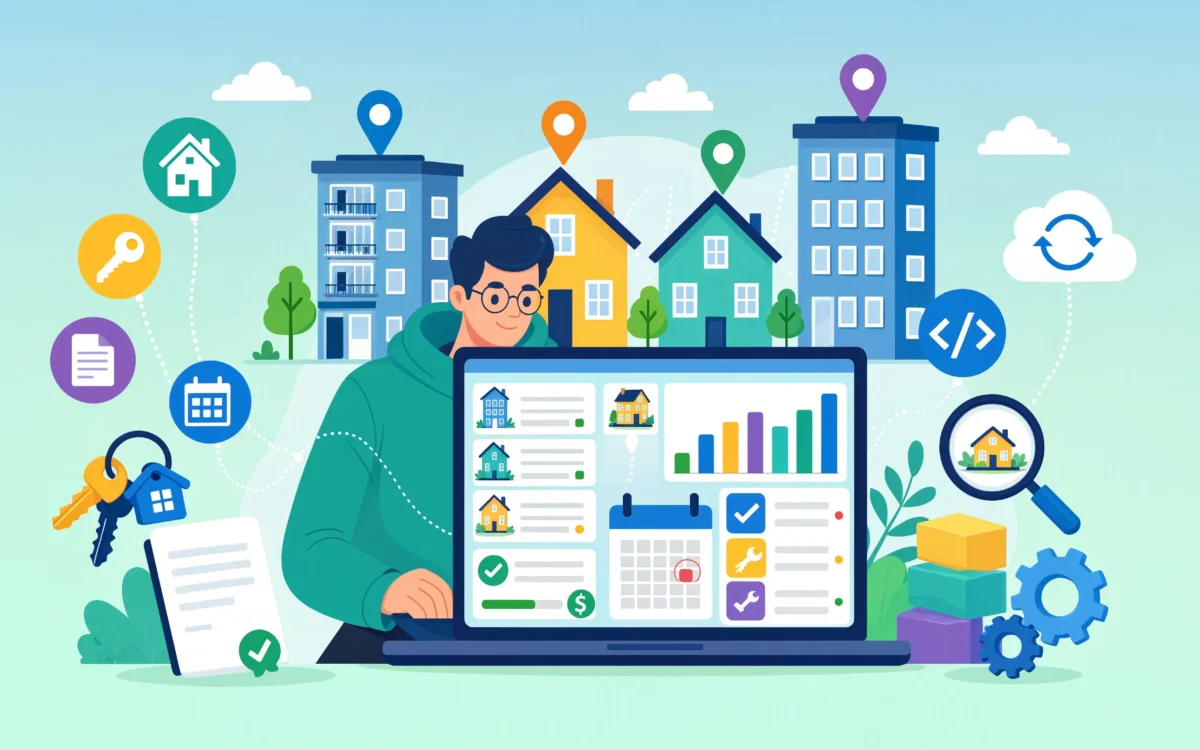
Real Estate Management Software Development Guide
Table of Contents
- Why Property Managers Outgrow Generic Tools
- What Real Estate Management Software Actually Needs to Do
- Core Modules Worth Building
- Architecture Choices That Matter
- Integrations That Determine Adoption
- The Development Process
- Starting With a Focused MVP
- Pricing a Real Estate Platform
- Build Custom or License an Existing Platform
- What the Build Actually Costs
- Choosing a Development Partner
- Common Mistakes in Real Estate Software Projects
- Conclusion
A property manager overseeing 40 units once described her workday as “three different tools pretending to be one system.” Rent collection lived in one app, maintenance requests came in through email and text messages she had to manually log, and lease documents sat in a shared drive that only she knew how to navigate. None of it talked to the others. Every month end close took her two full days, most of it spent reconciling numbers that should have matched automatically.
That story is common across the real estate industry, whether the business is residential property management, commercial leasing, or a brokerage juggling listings across multiple markets. Custom real estate management software development addresses this challenge directly, as off-the-shelf tools tend to cover only one slice of the workflow while leaving the rest to spreadsheets, email threads, and institutional memory. As a portfolio grows past a certain size, that patchwork stops being a minor inconvenience and starts costing real money in missed renewals, late maintenance response, and hours spent reconciling numbers by hand.
This guide covers what it actually takes to build custom real estate management software, from the first planning conversation through to a platform a team will actually use daily.
Why Property Managers Outgrow Generic Tools
Generic property management software is built to serve the widest possible range of landlords and managers, from someone with two rental units to a firm managing thousands. That breadth comes at a cost. The features that matter most to a specific business, a particular lease renewal workflow, a maintenance escalation rule, a reporting format a specific investor requires, often do not exist in the packaged tool, or exist as a rigid version that does not quite fit.
The result is the same pattern seen across every industry that outgrows generic software: workarounds accumulate, data gets duplicated across systems, and eventually someone spends a full day each month just making the numbers agree with each other.
What Real Estate Management Software Actually Needs to Do
Real estate software has to serve several different users at once, and each one needs something different from the same underlying data. Owners and investors need accurate financial reporting. Property managers need visibility into maintenance, occupancy, and lease timelines. Tenants need an easy way to pay rent and submit requests. Field staff need a mobile friendly way to log work without sitting at a desk.
A custom platform can serve all of these roles from a single source of truth, rather than forcing each group to check a different tool. Getting the requirements right across all these user types before development starts is essential, since clearly defined software requirements early on prevent a platform that serves property managers well but leaves tenants and owners with a clunky experience bolted on afterward.
Core Modules Worth Building
Most real estate management platforms end up needing some combination of the following:
- Lease and tenant management, including renewal tracking and document storage
- Rent collection with automated reminders and payment processing
- Maintenance request tracking, from submission through vendor assignment and completion
- Financial reporting that reconciles income and expenses per property or unit
- A tenant portal for payments, requests, and communication
- Listing and vacancy management for units currently on the market
- Owner facing dashboards for investors who want visibility without day to day involvement
Trying to build every module simultaneously is a common early mistake. The platforms that succeed tend to nail one or two core workflows first, usually rent collection and maintenance tracking, since those touch the business daily, then expand from there. Owner and tenant relationship tracking in particular raises the same question many operational businesses face when weighing custom CRM development against off the shelf tools.
Architecture Choices That Matter
If the platform needs to serve multiple property management companies, or multiple portfolios within one firm, a multi tenant architecture is usually the right foundation. It keeps each portfolio’s data properly isolated while allowing the underlying platform to be maintained and improved as a single codebase.
Understanding how multi-tenant SaaS architecture works matters even for a firm that only plans to use the software internally today, since real estate businesses tend to grow by acquisition or by adding new portfolios, and retrofitting a single tenant system later is far more disruptive than planning for isolation from the start.
Document management is another architecture decision worth getting right early. Leases, inspection reports, and financial statements need secure, versioned storage with clear access controls, since these documents often have legal weight and need to be retrievable years after a tenant has moved out.
Integrations That Determine Adoption
A real estate platform that does not connect to the tools a business already relies on rarely gets fully adopted. The most important integrations tend to be accounting software for financial reconciliation, payment processors for rent collection, and increasingly, communication tools that let tenants reach property managers through channels they already use, like text messaging rather than a portal they have to remember to check.
For businesses that also handle showings, viewings, or maintenance appointments, a scheduling layer matters as much as the financial side. Many real estate platforms end up needing the same kind of scheduling logic covered in a guide to building a booking system, since coordinating a property viewing or a maintenance visit is fundamentally the same problem as booking any other kind of appointment, just with different stakeholders on each end.
The Development Process
Real estate software follows a familiar development sequence, with a heavier emphasis on data modeling than most business applications, since properties, units, leases, tenants, and financial transactions all relate to each other in ways that are easy to get wrong early and expensive to fix later.
- Discovery. Understand the current workflow across every user type: owners, managers, tenants, and field staff.
- Data modeling. Design how properties, units, leases, and financial records relate to each other.
- Core build. Develop the highest impact workflow first, typically rent collection or maintenance tracking.
- Integrations. Connect accounting, payments, and communication tools once the core is stable.
- Testing with real portfolio data. Run the system alongside existing processes before a full cutover.
- Rollout and training. Property managers and field staff need hands on onboarding, since adoption depends on the tool actually being faster than what it replaces.
This process follows the same underlying logic as the general SaaS development life cycle, adapted for an industry where legal documents and financial accuracy carry more weight than in most consumer facing software. Many firms choose to run this process with an outside team rather than hiring in house, and a solid software development outsourcing guide is worth reading before signing any contract.
Starting With a Focused MVP
The real estate firms that get the most out of custom software rarely try to replace every tool at once. They pick the workflow causing the most pain, often rent collection and reconciliation, and build a focused solution for that first, before expanding into maintenance tracking, tenant communication, and owner reporting.
This mirrors the same principle behind any well scoped SaaS MVP: prove the core value with real users and real data before committing to the full feature set. It also means the team is working with a live system much sooner, which surfaces real workflow gaps far earlier than a long build cycle would.
Pricing a Real Estate Platform
Some real estate companies build software purely for internal use across their own portfolio. Others see an opportunity to license the platform to other property managers, turning an internal tool into a genuine product.
If licensing to other firms is even a possibility down the line, pricing structure is worth thinking through early, since adding multi tenant billing and tiered access to a system that was not designed for it later is a significant rebuild. Reviewing common SaaS pricing models is useful even for a team planning to stay internal only for now, since it clarifies how usage and value should be measured in the platform’s design.
Build Custom or License an Existing Platform
Not every real estate business needs a fully custom build. Some of the underlying pieces, payment processing, document e-signature, tenant screening, can be integrated from established providers rather than built from scratch, which shortens the timeline and reduces risk.
The right call usually comes down to how standard the business’s operations actually are. A firm running a fairly typical residential portfolio might do well starting from a white label foundation customized around its specific reporting needs, while a firm with a genuinely unusual model, mixed use developments, short term and long term rentals under one roof, institutional investor reporting requirements, usually benefits from a build that is custom from the data model up.
What the Build Actually Costs
Cost depends heavily on scope. A platform focused on a single workflow, like rent collection and basic reporting for one portfolio, costs far less than a full suite covering leasing, maintenance, tenant communication, and owner reporting across multiple property types.
The biggest cost drivers tend to be:
- Number of user roles the platform needs to serve well, owners, managers, tenants, and field staff each add complexity
- Depth of financial reporting and reconciliation required
- Number of third party integrations, especially payment processors and accounting software
- Whether field staff need a dedicated mobile experience for maintenance work
- Ongoing compliance needs, since lease and financial regulations vary by state and country
A general breakdown of SaaS development cost factors applies here, with financial reconciliation accuracy usually being the area that requires the most careful, and therefore costly, engineering attention.
Choosing a Development Partner
Real estate software sits at the intersection of financial accuracy, legal documentation, and day to day operations, which makes the choice of development partner more consequential than it might first appear. A team without experience in property management workflows may not understand why a late fee calculation needs to account for grace periods that vary by lease, or why maintenance requests need an audit trail that satisfies both the tenant and the owner.
The same due diligence that applies to choosing a SaaS development company in general matters here. It also helps to understand the broader discipline of custom application development, from scoping through delivery, and where a firm’s own team might benefit from software development consulting rather than a full outsourced build, before committing to any partner.
Common Mistakes in Real Estate Software Projects
A few patterns show up repeatedly in real estate software projects that stall or underdeliver:
- Trying to serve every user type equally well in version one, rather than prioritizing the workflow causing the most pain
- Underestimating how much of the current process lives in someone’s email or personal spreadsheet
- Building financial reporting late, after the core workflows are already in place, which forces a rework of the data model
- Choosing a development partner based on general software experience without checking property or real estate specific work
- Skipping proper training for field staff, who often have the least patience for a clunky tool
Avoiding these comes down to sequencing the build around the workflow that hurts the most first, and having a clear picture of what SaaS development actually involves before locking in scope and budget.
Conclusion
Real estate management software succeeds or fails based on whether it actually reflects how a portfolio is run, not how a generic vendor imagined every landlord operates. Start with the workflow causing the most pain, get the data model right early, and build outward from there, and the platform becomes something the team relies on daily rather than another tool competing with a spreadsheet.
If your portfolio has outgrown the tools you are patching together and you want to talk through what a custom platform would actually involve, the team at Software Flux Solutions has worked across booking, CRM, and operational SaaS platforms and can help you scope the right starting point.

Zainab Bibi
Senior SAAS Project Manager
1+ Years of Experience in SAAS Projects Management