Discovery Phase in Software Development: What It Is, Why It Matters, and How to Run It Right
Table of Contents
- What Is the Discovery Phase in Software Development?
- Why the Discovery Phase Is Not Optional
- Who Should Be Involved?
- The 7 Core Steps of the Discovery Phase
- Key Deliverables You Should Walk Away With
- Discovery Phase vs. Requirements Gathering: What Is the Difference?
- How Long Does the Discovery Phase Take and What Does It Cost?
- Common Mistakes Teams Make During Discovery
- Frequently Asked Questions
- Conclusion
Most software projects do not fail because the code was bad. They fail because the team started building before they truly understood what they were building, and for whom. That is the problem the discovery phase solves.
According to McKinsey, 45% of large IT projects run over budget, 7% miss their deadlines, and 56% deliver less value than originally expected. In the majority of those cases, inadequate upfront planning is a root cause. Spending a few weeks in discovery before writing a single line of code is one of the most cost-effective decisions a development team can make.
This guide explains exactly what the discovery phase in software development is, how to run it step by step, what it should produce, and how to avoid the mistakes that make it a wasted exercise.
What Is the Discovery Phase in Software Development?
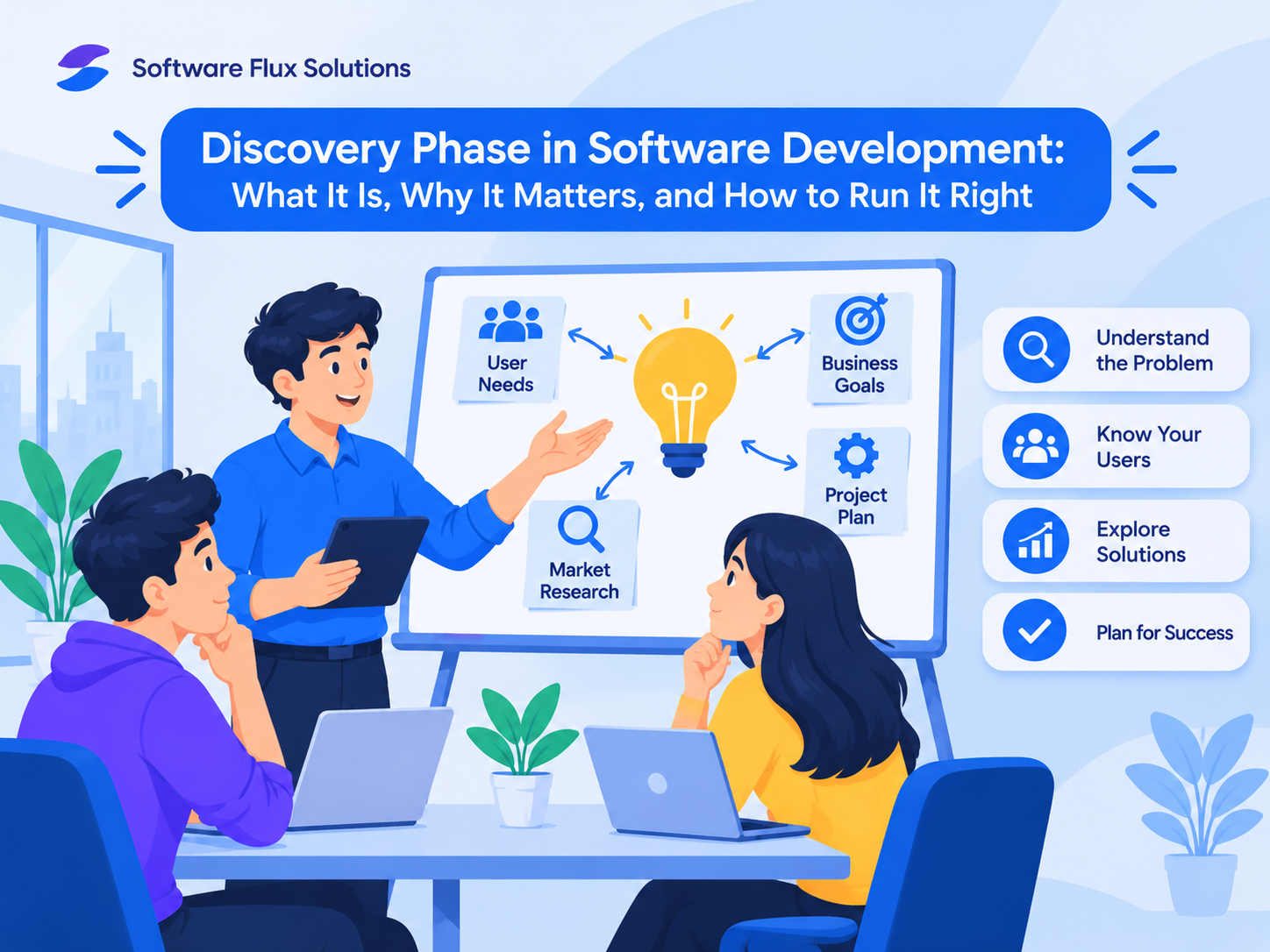
The discovery phase in software development is a structured, pre-development stage in which a project team investigates the problem, defines the product vision, clarifies requirements, and identifies risks before any code is written. It is sometimes called the scoping phase, the project initiation phase, or the product discovery phase, but the goal is always the same: replace assumptions with evidence.
Think of it this way. Before an architect draws a single line, they spend time understanding how the building will be used, who will use it, what the site conditions are, and what budget constraints exist. Discovery is the software equivalent of that preparation. Without it, you are building blind.
At Software Flux Solutions, the discovery phase is the starting point of every engagement we take on, whether that is a SaaS MVP, a custom booking system, or a complex enterprise platform. It is not an optional extra. It is the step that determines whether everything that follows is built on solid ground.
Why the Discovery Phase Is Not Optional
Here is a number worth keeping in mind: IBM research has shown that fixing a defect after launch costs roughly 15 times more than fixing it during planning. That gap grows even wider when the defect is not a bug in the code but a misunderstanding of what the product was supposed to do.
Skipping discovery does not save time. It moves risk from the beginning of a project to the middle and end, where fixing problems is far more expensive and disruptive.
Here is what happens when teams skip the discovery phase:
| What gets skipped | What it costs later |
|---|---|
| Defining the target user clearly | Features built for the wrong audience |
| Aligning stakeholders on scope | Disagreements mid-project, expensive rework |
| Identifying technical constraints early | Architecture problems discovered in development |
| Mapping integrations and data needs | Integration failures, delays, and additional sprint cycles |
| Risk assessment | Budget overruns when hidden problems surface |
| Setting clear acceptance criteria | Disputes over whether the product is “done” |
The table above is not theoretical. It reflects patterns that experienced development teams see repeatedly across projects of every size.
There is also a cost argument that runs in the opposite direction. A proper discovery phase often results in a smaller, sharper scope, which means you build less, launch faster, and spend less. When teams skip discovery, they tend to build more than they need because nobody made the hard decisions upfront.
Who Should Be Involved?
The discovery phase is a collaborative exercise, not a solo project. The specific people involved will vary depending on the size and type of project, but the roles below cover most situations.
From the client or product side:
- A business stakeholder who can speak to commercial goals and priorities
- A product owner or product manager who translates those goals into product decisions
- End users or user representatives, wherever possible
From the development side:
- A business analyst or project manager to structure the process and document findings
- A UX or product designer to map user flows and begin wireframing
- A technical lead or solutions architect to assess feasibility and flag risks
- A QA representative to think about testability and acceptance criteria early
One of the most common discovery mistakes is running it as a purely internal exercise, either entirely on the client side or entirely on the development side. The discovery phase works because it brings these perspectives together, often for the first time, and surfaces the gaps between what the client assumes is obvious and what the development team would need to actually build it.
If you are evaluating outsourced software development, the discovery phase is also a useful signal: partners who insist on running a proper discovery before quoting a fixed price are almost always more trustworthy than those who quote from a one-line brief.
The 7 Core Steps of the Discovery Phase
Step 1: Define the Problem and the Business Goals
Before anything else, the team needs to agree on what problem the software is solving and what a successful outcome looks like for the business. This sounds obvious, but it is frequently skipped or treated as a formality.
Good questions to answer at this stage:
- What specific problem does this product solve?
- Who experiences that problem, and how often?
- What does success look like in 6 months? In 2 years?
- What would have to be true for this project to be considered a failure?
The output of this step is a clear, written problem statement and a set of measurable business goals. These become the reference point against which every feature decision is made throughout the project.
Step 2: Identify and Research the Target Users
A product that does not connect with its users will not succeed, regardless of how technically accomplished it is. User research during discovery does not need to be exhaustive, but it needs to be real. At minimum, it means talking to actual users or close proxies, not just internal stakeholders describing what they think users want.
This step typically produces user personas: descriptions of the key user types, their goals, their frustrations, their existing tools, and their expectations. For a SaaS platform, this might mean understanding the difference between an admin user managing settings and an end user completing daily tasks, since those two roles may need very different interfaces.
User research at this stage also uncovers the jobs-to-be-done: the specific outcomes users are trying to achieve. That framing is far more useful than a feature list when it comes to making product decisions.
Step 3: Map the Competitive and Technical Landscape
Understanding what already exists, and where it falls short, helps the team define a sharper product direction. This includes:
- Reviewing competitor products and identifying gaps or weaknesses
- Understanding what tools users currently use and why they are inadequate
- Assessing what APIs, services, or platforms are available that could reduce build time
On the technical side, this step is about identifying constraints and opportunities early. What systems does the product need to integrate with? What data volumes should it handle? Are there compliance or security requirements, such as GDPR, HIPAA, or PCI DSS, that will shape the architecture? These questions are far cheaper to answer during discovery than during sprint five of development.
For products requiring software integrations, this step often reveals dependencies that would have caused serious problems if they had been discovered mid-build.
Step 4: Define and Prioritise Requirements
With the problem, users, and landscape understood, the team can now define what the product needs to do. This includes both functional requirements, the specific features and behaviors the system must have, and non-functional requirements, the performance, security, scalability, and reliability standards it must meet.
The critical discipline here is prioritisation. Discovery is not an invitation to list everything anyone could ever want. It is an opportunity to separate what is essential for the first version from what can wait. A tool like MoSCoW prioritisation, which sorts requirements into Must have, Should have, Could have, and Won’t have for now, is useful here.
A well-structured requirements document produced in discovery is the foundation for a software development statement of work and for accurate project estimation.
Step 5: Produce Initial Designs and Prototypes
Once requirements are defined and prioritised, designers can begin turning them into visual artifacts. These do not need to be pixel-perfect at the discovery stage. The purpose of wireframes and low-fidelity prototypes is to test assumptions quickly and cheaply.
A clickable prototype built during discovery can be shown to users to validate that the proposed flows make sense before any code is written. The feedback gathered here often reveals significant mismatches between what the team assumed and what users actually need, and finding those mismatches in a prototype costs a fraction of finding them in a finished product.
This step connects closely with interaction design: how the product responds to user actions is a core part of what makes it feel easy or frustrating to use, and those decisions are best made before development begins.
Step 6: Assess Technical Feasibility and Plan the Architecture
The technical lead and solutions architect use the information gathered so far to assess feasibility and propose an architecture. Key decisions at this stage include:
- The technology stack: frontend framework, backend language, database
- Multi-tenancy strategy for SaaS products
- Authentication approach, including single sign-on where needed
- Infrastructure and hosting platform
- Data model and integration architecture
- Security and compliance approach
These decisions are recorded in a technical specification or architecture document. For teams building a SaaS development life cycle, this document is what the development team builds from. Getting it right during discovery avoids the painful, expensive refactors that happen when architectural decisions are made on the fly.
Step 7: Identify Risks and Define the Project Scope
The final step in discovery is to bring everything together into a clear, agreed scope and to surface and document the risks that could affect the project. This includes:
- Technical risks: dependencies on third parties, unproven technologies, or complex integrations
- Product risks: assumptions about user behaviour that have not been validated
- Commercial risks: budget or timeline constraints that limit what can be built
- Organisational risks: decision-making bottlenecks or competing priorities on the client side
A risk register does not need to be elaborate. Even a simple list of identified risks, their likelihood, their potential impact, and the planned mitigation is enormously valuable when a project runs into difficulty, as most projects do at some point.
The scope document that comes out of this step is not a final, frozen commitment. On agile projects, the scope will evolve as the team learns more. But it creates a shared baseline: an agreed starting point that everyone has signed off on, which prevents the endless scope debates that derail so many projects.
Key Deliverables You Should Walk Away With
A discovery phase that does not produce clear, written outputs is not a discovery phase. It is a series of conversations. The following deliverables are what transform those conversations into something the development team can actually build from.
| Deliverable | What it contains |
|---|---|
| Problem statement | Clear description of the problem being solved and for whom |
| User personas | Descriptions of key user types, their goals, and their pain points |
| Requirements document | Prioritised functional and non-functional requirements |
| Wireframes or prototype | Visual representation of key screens and user flows |
| Technical specification | Architecture decisions, tech stack, integration map |
| Risk register | Identified risks with likelihood, impact, and mitigation |
| Project scope and estimates | Agreed scope, timeline estimate, and cost range |
If you are using the discovery phase output to produce a software development statement of work, these documents provide the detail that makes the SOW accurate and defensible.
Discovery Phase vs. Requirements Gathering: What Is the Difference?
This distinction matters because the two terms are often used interchangeably, but they describe different things.
Requirements gathering is a component of the discovery phase. It is the activity of documenting what the system must do. The discovery phase is broader: it encompasses understanding the problem and the users, researching the competitive landscape, assessing technical feasibility, producing initial designs, and identifying risks. Requirements gathering feeds into the discovery phase rather than being the whole of it.
A project that skips to requirements gathering without doing the broader discovery work often ends up with a requirements document that accurately describes the wrong thing. The requirements may be internally consistent, but they may not reflect actual user needs or technical realities.
This distinction also matters when working with a development partner. A team that offers only requirements gathering is offering a narrower service than a team that runs a full discovery phase. If you are evaluating development partners for a custom software project, it is worth asking specifically what their discovery process covers.
How Long Does the Discovery Phase Take and What Does It Cost?
The duration and cost vary significantly depending on the complexity of the product and the number of stakeholders involved. As a rough guide:
Simple products (a focused SaaS tool, a single-purpose booking system, an internal tool): 1 to 3 weeks of discovery, often included in the overall engagement cost or priced as a separate fixed-fee phase of around 5 to 15% of the estimated total project cost.
Standard products (a multi-role SaaS platform, a marketplace, a product with several integrations): 3 to 6 weeks, typically a more significant investment that reflects the complexity of aligning multiple stakeholders and mapping more complex requirements.
Complex or enterprise products (products with regulatory compliance requirements, many integrations, or large organisations with multiple business units involved): 6 to 12 weeks or more, with discovery sometimes running as a programme in its own right.
One useful frame: if the total project is likely to cost $50,000, spending $3,000 to $7,000 on a thorough discovery phase is almost always a sound investment. The alternative, discovering that the approach was wrong after spending $30,000 on development, is far more expensive.
For SaaS MVP development specifically, a focused discovery phase of two to three weeks is usually sufficient to produce a scope and architecture that the development team can build to with confidence.
Common Mistakes Teams Make During Discovery
Running discovery without real users. Talking only to internal stakeholders and then calling it user research is one of the most common and most costly mistakes. Internal stakeholders frequently describe what they think users want rather than what users actually do.
Treating discovery as a box to tick. Discovery only works if the team is genuinely open to what it reveals. If the scope, the technology, and the timeline are already fixed before discovery begins, the exercise is performative. Some of the most valuable outcomes of discovery are the things it rules out.
Producing outputs nobody reads. A 100-page requirements document that no developer ever opens is not a useful discovery deliverable. Keep outputs concise, visual where possible, and structured for the people who will use them.
Skipping the technical feasibility step. Discovery without input from a technical lead often produces a beautifully documented set of requirements that cannot be built as described, at least not within the available budget and timeline.
Not revisiting the scope at the end. Discovery regularly reveals that the original scope was too large for the available budget, or that some requirements are far more complex than initially assumed. Teams that do not revisit and adjust the scope at the end of discovery set themselves up for the painful mid-project conversations they were trying to avoid.
Skipping discovery for projects involving legacy systems. Products that need to connect with or replace legacy software or involve complex integrations almost always contain hidden complexity. Discovery is where that complexity gets surfaced.
Frequently Asked Questions
What is the discovery phase in software development?
The discovery phase in software development is a structured pre-development stage in which a project team defines the problem, researches users and the market, clarifies requirements, assesses technical feasibility, produces initial designs, and identifies risks before any development work begins. Its purpose is to replace assumptions with evidence and ensure the development team builds the right thing.
How long does the discovery phase take?
For simple products, one to three weeks is usually sufficient. Standard multi-role products typically need three to six weeks. Complex or enterprise products may require six to twelve weeks or more. The duration depends on the number of stakeholders, the complexity of the integrations, and the degree of uncertainty at the start of the project.
What is the difference between discovery and requirements gathering?
Requirements gathering is one activity within the broader discovery phase. Discovery also includes user research, competitive analysis, technical feasibility assessment, initial design, and risk identification. A project that only does requirements gathering, without the broader discovery work, often ends up accurately documenting the wrong thing.
Is the discovery phase only for large projects?
No. Even small projects benefit significantly from a focused discovery phase. The scale of the discovery should be proportionate to the scale of the project, but skipping it entirely because the project seems small frequently leads to scope creep, misaligned expectations, and rework that costs more than the discovery would have.
Who pays for the discovery phase?
Usually the client, as a fixed-fee engagement separate from the main development contract. Some development agencies include a lightweight discovery as part of their sales process, though a thorough discovery that produces usable deliverables is almost always billed as a paid engagement. The investment is typically a small percentage of the overall project cost.
What happens after the discovery phase?
The outputs of discovery, including the requirements document, wireframes, technical specification, and project scope, feed directly into the planning and development phase. The development team uses these to structure sprints, produce detailed designs, and begin building. Discovery outputs also form the basis for the project’s statement of work and serve as the reference point for scope management throughout development.
Can you skip the discovery phase for an MVP?
Skipping discovery for an MVP is especially risky because MVP development is specifically about building the right thing quickly. Without discovery, teams frequently build a first version of the wrong product. A focused two to three week discovery phase for an MVP is almost always time well spent, and it is what separates MVPs that go on to attract users from those that get quietly shelved.
Conclusion
The discovery phase in software development is not a preliminary formality. It is the step that determines whether the rest of the project is built on solid ground or on assumptions that will eventually crack under pressure.
Done well, it aligns stakeholders before misalignments become expensive. It surfaces technical risks before they become sprint-breaking blockers. It produces a scope that the development team can actually build, rather than an optimistic estimate based on a vague brief. And it gives clients the confidence that comes from knowing exactly what they are committing to before they commit.
Every project type benefits from a structured discovery phase: SaaS platforms, booking systems, real estate software, logistics tools, and everything in between.
If you are planning a software project and want a development partner that treats discovery as seriously as the build itself, get in touch with Software Flux Solutions. We will help you define the problem clearly, build the right product, and launch with confidence.

Zainab Bibi
Senior SAAS Project Manager
1+ Years of Experience in SAAS Projects Management